Building Physical AI ventures at e-Novia Investor Day
How e-Novia’s Physical AI Investor Day connected startups with investors and industry...

In the first six months of 2026, European investors put 11 billion euros into deep tech, against the 14 billion invested across all of 2025, after four years in which volumes had moved within a relatively narrow band, between twelve and fifteen billion, as the Venture Capital Report Italy Q2-26 & H1-26 shows, published by Growth Capital together with Italian Tech Alliance, which dedicates an entire chapter of analysis to deep tech. The sector’s share of total European venture capital has climbed to 25% of amount invested, up from 20% last year and 13% in 2021, the highest share on record.
Growth is being driven above all by larger deals, so much so that three of the top five European raises of the half are deep tech deals outright, Germany’s Helsing, which builds AI software and systems for defence, with a 1.6 billion euro Series E, Sweden’s Stegra, which produces low-emission steel using hydrogen instead of coal, with 1.4 billion euros in a growth equity round, and Germany’s Neura Robotics, which builds AI-powered humanoid robots, with a 1.2 billion euro Series C.
Deep tech deals share a few traits that set them apart from the rest of venture capital, starting with the hardware component they often include, from robotics to advanced manufacturing, from space to nanotechnology, which brings longer development cycles, physical prototyping, testing and certification before a sellable product exists. The result is a capital requirement that stays high well beyond the early stages, while the competitive advantage is built on intellectual property rather than a new business model applied to an already mature technology, as we also cover in our what is deep tech explainer.
Behind the recent growth are also two structural forces the report identifies, on one side the push toward European technological sovereignty, fuelled by geopolitical tensions and the return of manufacturing capacity to the continent, on the other the role of public capital, from European programmes such as the European Innovation Council, the EU instrument that funds the riskiest early-stage deep tech through grants and equity investment, to national funds, which together absorb part of the early-stage risk through non-dilutive instruments and so encourage private capital into later rounds. It’s the same de-risking mechanism behind the launch of several billion-euro-plus European deep tech funds, such as Mundi Ventures’ Kembara Fund I, which closed a first close of 750 million euros in February 2026, and Jolt Capital V, closed at 600 million euros in September 2025, joined by Seaya’s Growth Tech Fund I and KfW Capital’s The Germany Fund, both just launched in 2026 with the same target, alongside the 5 billion euro EIC Scaleup Europe Fund, still selecting its manager.
For e-Novia, the most telling figure isn’t so much the growth in capital available at the early stages, but an ecosystem’s real ability to carry its deep tech companies through to scale-up without depending almost entirely on foreign capital, because while public capital and the new European funds help reduce technological risk at the start of the journey, the harder challenge lies further upstream, in turning a scientific discovery into a company structured enough to attract capital in later stages too, the stages where the European market still shows the greatest reliance on non-local investors.
Italy’s numbers in the report bear this out. Capital invested in Italian deep tech grew from 59 million euros in 2021 to 244 million in 2025, taking the sector’s share of total Italian venture capital from 5% to over 11%, with a 22% peak in 2023 tied to a handful of particularly large deals, while the first half of 2026 has already raised 97 million euros across seventeen rounds, including the Series D of Piedmont-based space company D-Orbit, part of a 110 million euro round of which 45 million was primary capital, preceded the previous quarter by the 34 million euro Series B of Lombardy-based 3D printing company Caracol. Confirming the role of public capital we mentioned, CDP Venture Capital appears among the investors in four of the five leading Italian deep tech deals tracked by the report over the past year and a half, from Generative Bionics to Caracol, CamGraphIC and Dronus.
The same report also confirms the limit we mentioned, international investors took part in only one round in five among the Italian deep tech deals tracked between 2025 and the first half of 2026, yet those rounds account for 53% of total capital raised, confirming that local capital is growing at the early stages while the ability to fund scale-up still rests mostly with investors from abroad.
It’s on this critical passage that e-Novia’s Venture Studio model contributes, acting as an industrial and technological co-founder for ventures born out of research, an approach covered in more depth in our Startup Studio explainer, and which in practice means pairing the technology with the expertise needed to build its business model, bridging it with industrial partners able to provide manufacturing capacity and market channels, and structuring the conversation with investors during the stages when technological risk is still high, cutting the time and cost of industrialisation.
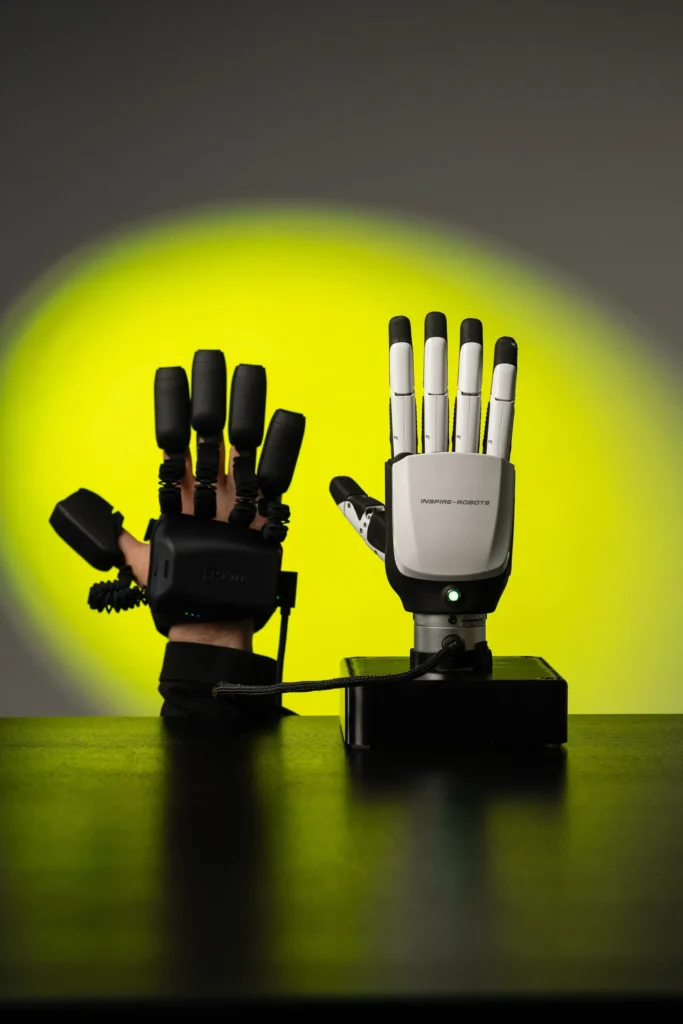
Weart, the e-Novia Venture Studio company that has developed a wearable haptic technology to digitise the sense of touch for XR experiences, is an example of this kind of journey, a technology born from a specific scientific bet and carried toward market applications in XR.
Companies evaluating how to structure this work internally can learn more on e-Novia’s Venture Studio page.