Building Physical AI ventures at e-Novia Investor Day
How e-Novia’s Physical AI Investor Day connected startups with investors and industry...

In today’s business world, digital and physical technologies are mixing fast. Understanding the 4 types of innovation is no longer just theory. It is a basic strategic need for your company to survive, change, and grow in the long term.
Joseph Alois Schumpeter, a famous economist, said that “carrying out innovations is the only function which is fundamental in history”. He believed that business leaders must always replace the good things of today with the new things of tomorrow.
This statement might sound too strong. A company’s success depends on many things: good daily operations, smart money management, and a strong supply chain. However, Schumpeter is right about modern markets. If you work in a highly competitive sector, being efficient is not enough. Companies that stop innovating will just become perfectly efficient at making old things. They will be left behind by competitors who change the rules. Today, products and processes are becoming smart systems, making this idea more true than ever.
Without a clear innovation strategy, you take a big risk. You might buy very expensive technology when you only need a small change. Or, you might make a small change when the market really needs a revolution.
At e-Novia, we guide companies in their tech and strategic evolution, from the first idea to full-scale production. In this article, we explain the 4 types of innovation to help you understand market challenges and turn them into real opportunities.
To invest well, manage tech risks, and plan products, businesses use a standard matrix. This matrix looks at market impact and how new the technology is. It helps companies avoid wasting money and choose the right plan for every problem.
Here is how these 4 strategies work in the real industrial world.
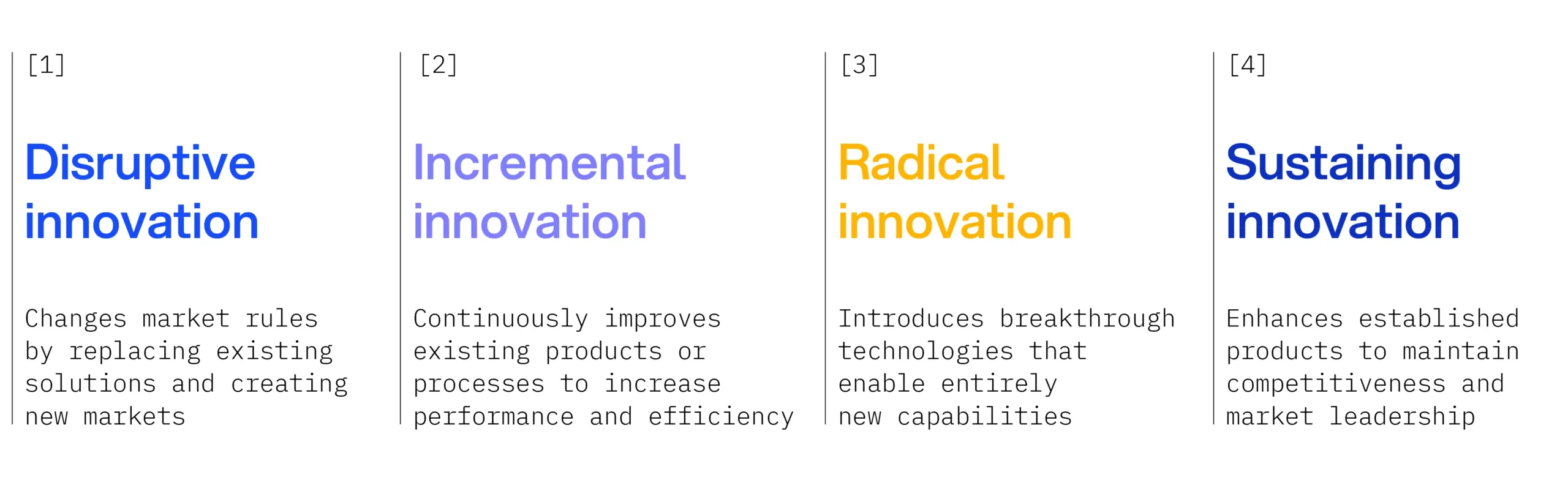
It changes market rules by replacing existing solutions and creating new markets.
Disruptive innovation, a concept made famous by Clayton Christensen, does not just make a product a little better. It makes old business models useless. It often starts in small, ignored markets with simple solutions. Then, it grows fast and beats the market leaders.
A famous example is the smartphone, like the Apple iPhone. It put a phone, camera, map, music player, and computer in one single device. This did not just improve communication; it replaced old cell phones completely.
In the B2B tech world, disruption is hard for big companies. It requires high speed and the ability to take big risks (which is hard with strict internal rules). Because of this, the best way is often to use an external approach. Through our Venture Studio model, we build independent deep tech startups. They can test new technologies quickly and freely. Once the solution works, they scale it up for the industry.
It constantly improves existing products or processes to increase performance and efficiency.
If disruption makes the news, incremental innovation pays the bills. It does not change the market, but it makes the company stronger step by step. In manufacturing, this usually means process innovation. It cuts waste, saves production time, and lowers costs.
A great example is InstaFactory, the mobile factory for Mutti.
Mutti is a top international tomato company with a strong focus on quality. Their challenge was complex: improve production and reduce environmental impact, without losing product quality. We supported Mutti in designing and building a flexible mobile factory. It processes tomatoes directly in the field. Working with their team and suppliers, e-Novia managed the tech integration and the field operations. The results? A huge drop in CO2 emissions thanks to a shorter supply chain, less waste, and premium tomato sauce processed right after picking.
It introduces breakthrough technologies that enable completely new capabilities.
Radical innovation needs deep Research and Development (R&D). It uses huge tech jumps to give amazing performance that was impossible before. It creates a big gap between companies that use it and those that do not.
This is where e-Novia works best. We design physical solutions powered by Artificial Intelligence (Physical AI) with a human-centered approach. This maximizes human and technological potential, opening the door to new business models and new markets.
Putting AI, smart software, and precision mechatronics into physical devices gives a huge advantage. We do not just collect data. We design machines and vehicles that can see their environment, make decisions on their own, and adapt to the user in real time.
It optimizes established products to maintain competitiveness and market leadership.
Sustaining innovation is essential for market leaders. When a company leads a sector, its main job is to protect its position. It must give customers what they expect as their needs grow. This means taking a highly successful product and adding new digital functions or advanced sensors.
A great Italian example is TrackTribe by Brembo. Brembo is a global leader in high-performance brakes. They noticed a specific need: track riders wanted to track their riding data easily, just like professional racing teams. At e-Novia, together with our company e-Shock, we helped Brembo build this vision. We created the first native digital ecosystem for Brembo Performance.
TrackTribe uses a special app connected to a device on the motorcycle. This device has a GPS and an inertial platform. Safety is the top priority, so the system only turns on when the bike is on a race track. Riders can analyze their sessions, improve their skills, and connect with a community of riders. This makes the Brembo brand experience even stronger. Learn more about Brembo TrackTribe.
Managing the 4 types of innovation is not about guessing. It needs a highly structured plan, from the top managers down to the factory floor.
The best companies balance their investments. On one side, they put money into their current products (incremental and sustaining innovation) to make profits today. On the other side, they build dedicated teams to explore the future (radical and disruptive innovation).
To start this journey, you need to follow these steps: