Building Physical AI ventures at e-Novia Investor Day
How e-Novia’s Physical AI Investor Day connected startups with investors and industry...

For startups and corporate initiatives operating in Deep Tech, developing cutting-edge technology is only the first step. Once a proof of concept passes the testing phase, founders and management systematically hit the real barrier to entry: industrialization and Go-to-Market (GTM) execution.
Unlike software (SaaS) products, where time-to-market is short and marginal distribution costs are near zero, launching a Physical AI product (which combines hardware, sensors, artificial intelligence, and mechatronics) requires complex market validation and a commercial strategy developed in parallel with engineering.
The crucial question for innovation leaders is simple: what makes the commercial launch of smart hardware so different and complex compared to a pure software solution?
In the software world, releasing an incomplete MVP (Minimum Viable Product) is a common practice to quickly test the market’s reaction (the fail fast approach). In Deep Tech and hardware, this approach is impossible. A mechatronic product must meet strict safety, certification, and durability standards before it even reaches the first client. Every hardware iteration requires months and heavy capital. The fatal mistake is spending years focusing only on technical development (features) without gathering real market signals, arriving late with a product that is perfectly engineered but commercially irrelevant.
Selling a Physical AI product often means revolutionizing the client’s entire business model. It is not just about selling a component, but about enabling new “as-a-service” models, such as predictive maintenance or continuous monitoring. From day one, the GTM strategy must educate the market. It must clearly define the ROI (Return on Investment) for the client, highlighting the financial and operational benefits compared to traditional technologies or the costs generated by inefficiencies and machine downtime. Furthermore, it must build pricing models that reflect the long-term value generated, not just the hardware manufacturing cost.
In highly technological projects, the founding team is usually dominated by engineering or scientific profiles. While technical excellence is guaranteed, sales dynamics, identifying the ICP (Ideal Customer Profile), and early commercial conversations are often treated as an afterthought. In reality, in complex B2B markets, the client does not just buy technology; they buy the reliability, the vision, and the scalability of the project.
CoTackling technological risk (building a reliable hardware-software product) and market risk (finding buyers) at the same time is extremely difficult for a single team, no matter how brilliant.
To mitigate this double risk, the Venture Studio model proves essential for Deep Tech startups and Corporate Venture projects.
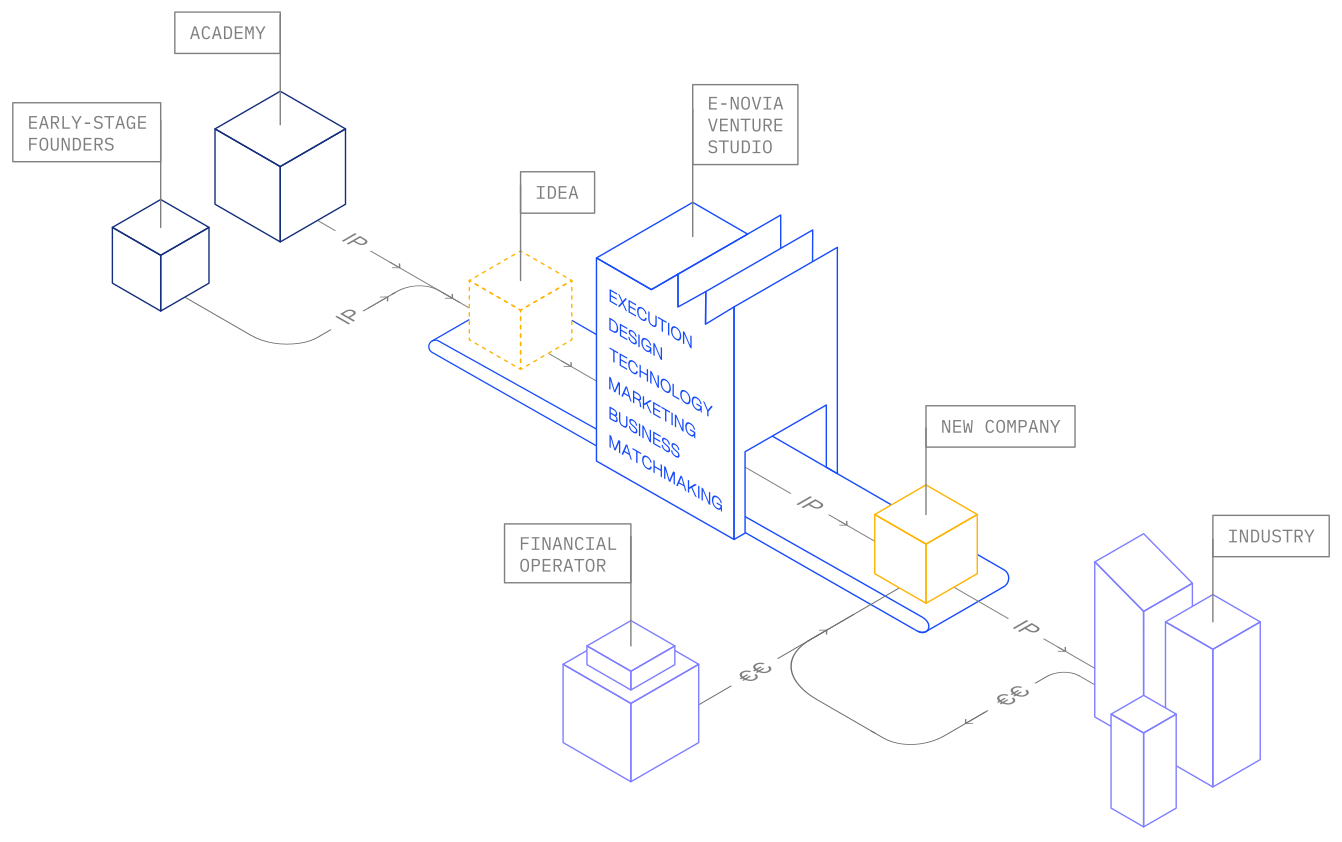
With our dedicated program for researchers and startuppers, we do more than just provide the engineering ecosystem needed to turn a patent or an idea into an industrial product. Our model acts as a true catalyst for Go-to-Market:
In Deep Tech, technological superiority gets you noticed. But excellent Go-to-Market execution determines the survival and scalability of the project.
👉 Discover how e-Novia, through its Venture Studio model, helps startups and companies successfully bring Deep Tech and Physical AI innovations to the market.