Urban Mobility Data: Why the Right Data Matters More Than the Volume
At Milan’s MOBIDAYS, Blimp shares how data helps identify where to act on urban...

An industrial Proof of Concept is a validation phase designed to understand whether a technology solution can work in realistic operating conditions before significant development budgets are committed.
In B2B innovation, a POC is not just a preliminary presentation of an idea. It is a practical test of one or more critical assumptions. It may focus on integrating a sensor into an existing product, testing an algorithm on real data or assessing whether a process step can be automated without disrupting operations.
For companies, the value of an industrial Proof of Concept lies in risk reduction. Before moving into more expensive development phases, management can understand whether the solution is technically feasible, whether it generates measurable value and whether it deserves a next prototyping phase.
An industrial Proof of Concept is a practical feasibility check. It is not the final product and does not need to include definitive finishes or final interfaces.
Its goal is narrower and more strategic. It must answer a clear question. Can the technology be integrated into an existing operating environment? Is the data reliable enough? Can the process be automated while maintaining control?
This is why a POC is different from a demo. A demo shows potential. A POC measures it. This difference matters in industrial decision-making, where a technology must prove that it can create value within real constraints such as cost, timing and performance.
Every innovation project contains uncertainty. In the early stages, companies often make decisions with incomplete information. Risk increases when the project involves physical components, software and integration with existing systems.
An industrial Proof of Concept makes it possible to isolate the riskiest assumptions and test them while the cost of change is still manageable. If a major issue emerges close to production, fixing it may require redesign and delays. If it emerges during a POC, it becomes useful evidence for deciding how to proceed.
The benefit is not only technical. A well-designed POC improves decision quality. It helps teams compare alternatives, align stakeholders and define a more reliable path toward product development.
An industrial Proof of Concept is useful when a company needs to validate a new solution but does not yet have enough evidence to move into full development.
It is often needed when a promising technology must be added to an existing product. In that case, the POC can test physical compatibility, performance and data collection.
It is also valuable when a company wants to introduce automation into an industrial process. Before changing an operating flow, the team needs to understand which activities can be automated and which constraints must be respected.
The POC becomes especially important in projects involving AI, sensors and embedded systems. In these cases, feasibility does not depend on one component alone. It depends on the interaction between data, hardware and the operating environment.
An industrial Proof of Concept and rapid prototyping are closely connected, but they are not the same thing. The POC answers the question “can it work?”. Rapid prototyping turns that answer into a more complete artefact.
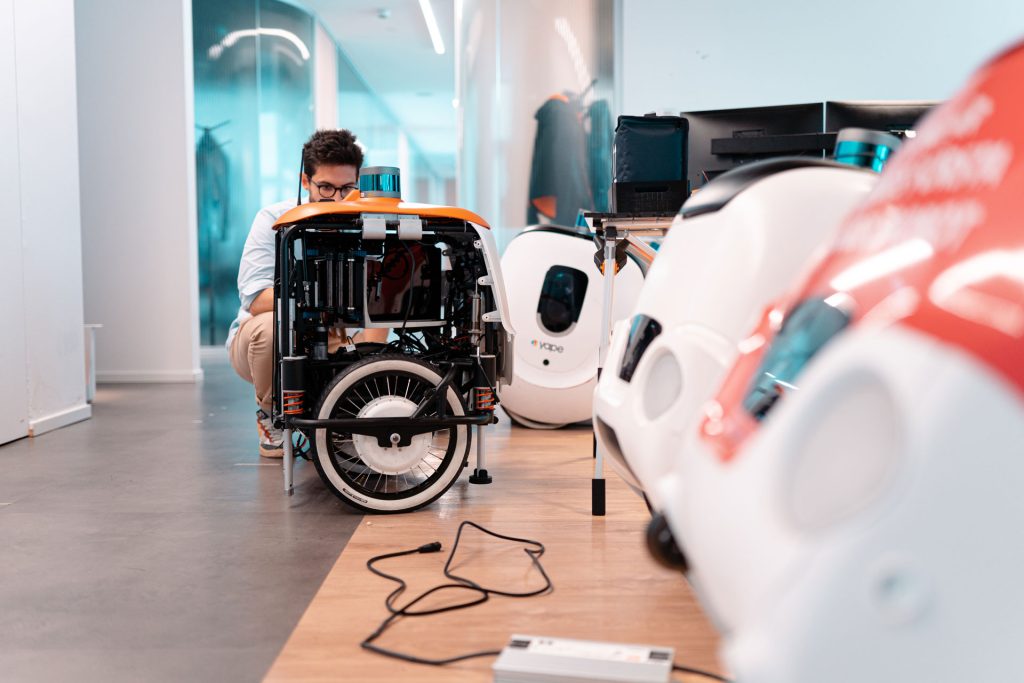
The two activities should be designed as part of the same development path. The POC reduces uncertainty around the core assumption. Rapid prototyping then helps test form, function and usability more progressively.
In industrial projects, this sequence helps avoid two common mistakes. The first is building a complex prototype too early. The second is staying too long in the concept phase without producing operational evidence.
To go deeper into this topic, read e-Novia’s article on rapid prototyping in product development.
An effective industrial Proof of Concept does not start from the technology. It starts from the question the company needs to validate. The more precise the question, the more useful the POC becomes as a decision-making tool.
The first step is to identify the critical assumption. It may concern the accuracy of a sensor, the stability of a communication flow or the ability of an algorithm to work on real data.
When a POC tries to validate too many assumptions at once, it loses clarity. The result is often an unfinished prototype that does not answer a meaningful question. A strong POC should be focused, measurable and connected to a clear next decision.
An industrial POC must generate evidence. Metrics depend on the project, but they may include accuracy, stability, response time or data quality.
Defining metrics is a strategic part of the work. Without clear evaluation criteria, the POC risks becoming a subjective demonstration. With shared metrics, it becomes a governance tool for both technical teams and decision-makers.
A POC is ready for the next phase when it has reduced the main uncertainty. This does not mean that the solution is ready for industrialization. It means that the company can decide with greater confidence how to move forward.
The next step may be a functional prototype, a real-world test or a more robust engineering phase. The decision depends on the maturity reached and the remaining risk.
Across hundreds of innovation projects, e-Novia has often used Proofs of Concept to turn technological intuition into industrial evidence. The following examples are anonymized and based on real project experience.
In one project for a high-complexity manufacturing environment, the need was to improve operator safety during a delicate manual operation. The challenge was not only process efficiency. It also involved ergonomics and repeatability.
The industrial Proof of Concept tested a new workstation architecture and assessed whether the system could reduce operator exposure to risk without slowing down the task.
The value of the POC was in the early validation of human-machine interaction. Before changing the production process, the company could observe real constraints, friction points and expected benefits.
In a manufacturing project, the objective was to make internal technical documentation easier to access. The operational problem was clear: the information existed, but it was difficult to retrieve fast enough during everyday work.
The POC tested the use of LLM-based models to structure and query process documentation. The goal was not to introduce AI for its own sake. The goal was to understand whether a natural language system could reduce dependence on internal experts.
Validation focused on answer quality, relevance and retrieval reliability. In this case, the industrial Proof of Concept helped identify where AI could create operational value.
In a project involving pressure equipment, the challenge was to improve long-term reliability. The technical focus was the monitoring of degradation phenomena that are difficult to observe through traditional inspections.
The POC explored the possibility of introducing continuous measurements and digital tools to support predictive maintenance. The question was practical: can the system collect useful data to anticipate risk conditions?
The value of the project was in making a critical phenomenon measurable. Before moving toward full development, the industrial Proof of Concept made it possible to assess technical feasibility and fit with the operating environment.
An industrial Proof of Concept is especially useful when innovation must enter complex existing systems. In these contexts, success does not depend only on the quality of the technology. It depends on whether that technology can fit into real products and processes.
In intelligent products, a POC can verify whether sensors collect reliable data and whether connectivity supports proper information management.
The value lies in making the relationship between the physical component and the data visible. An unstable measurement or an unclear interface can compromise the entire service model.
In industrial processes, a POC can verify whether a repetitive activity can be automated without creating new risks.
This approach is useful when a company wants to improve efficiency while avoiding invasive changes to existing workflows. A POC allows the solution to be tested in a controlled scope before it is extended.
When artificial intelligence is applied to products or machines, the POC helps verify data quality and the usefulness of the output. It is not enough for a model to work in simulation. It must produce reliable information in the context where it will be used.
This is why an AI-related industrial POC should consider data collection, environmental conditions and integration with existing systems. The goal is not to prove that AI is possible. The goal is to understand whether it creates a measurable improvement.
For e-Novia, the industrial Proof of Concept is an operational tool to turn innovation into evidence. It helps companies understand whether a technology can become a product or a new process.
Through its innovation consulting, e-Novia supports companies in defining the need and validating the solution in applied contexts. The work does not stop at ideation. It moves into solution design and interpretation of results.
This approach is particularly relevant when the project requires different technical capabilities to work together. Sensors, software, firmware, mechanics and AI must be designed as parts of the same system. In industrial innovation, the ability to integrate these capabilities often makes the difference between an interesting test and a solution ready for further development.
An industrial Proof of Concept therefore becomes a de-risking lever. It reduces uncertainty, makes technological potential measurable and helps build a stronger path toward market adoption.
👉 Discover how e-Novia supports companies and R&D teams in validating new industrial solutions, from Proof of Concept to prototyping and product development.