Building Physical AI ventures at e-Novia Investor Day
How e-Novia’s Physical AI Investor Day connected startups with investors and industry...

Industrial IoT, or IIoT, applies the Internet of Things to industrial systems. It connects machines, sensors, PLCs, edge devices and software platforms to make industrial data usable in operational and business decision-making.
The value does not come from connecting more assets. It comes from improving control over processes, anticipating operational issues and building new forms of efficiency, quality and service.
Industrial IoT is the infrastructure that enables machines, plants and industrial products to generate actionable data.
In a production environment, every asset produces signals about how it operates. Machine status, energy consumption, vibration, temperature, cycle time, downtime and process parameters are often available only in fragmented systems, or after the event.
IIoT changes this model. Data becomes accessible, connected to the process and available to support operational decisions. Technology is not the objective. It is the means to reduce uncertainty, improve control and make decision-making more scalable.
For an industrial company, asking what Industrial IoT is means asking which decisions can be improved through data that is more reliable, timely and aligned with the real operating context.
Consumer IoT connects devices used in everyday life. Industrial IoT operates in environments where reliability, continuity and safety have a direct impact on business performance.
In a factory, incomplete or unavailable data can affect the quality of a batch, the planning of maintenance, energy consumption or the continuity of a production line. This is why an IIoT system must integrate with the existing infrastructure, including control systems, industrial software and Programmable Logic Controllers.
The main difference is operational. In Industrial IoT, data is not collected for monitoring alone. It is used to improve decisions in complex environments where time, quality and cost are tightly connected.
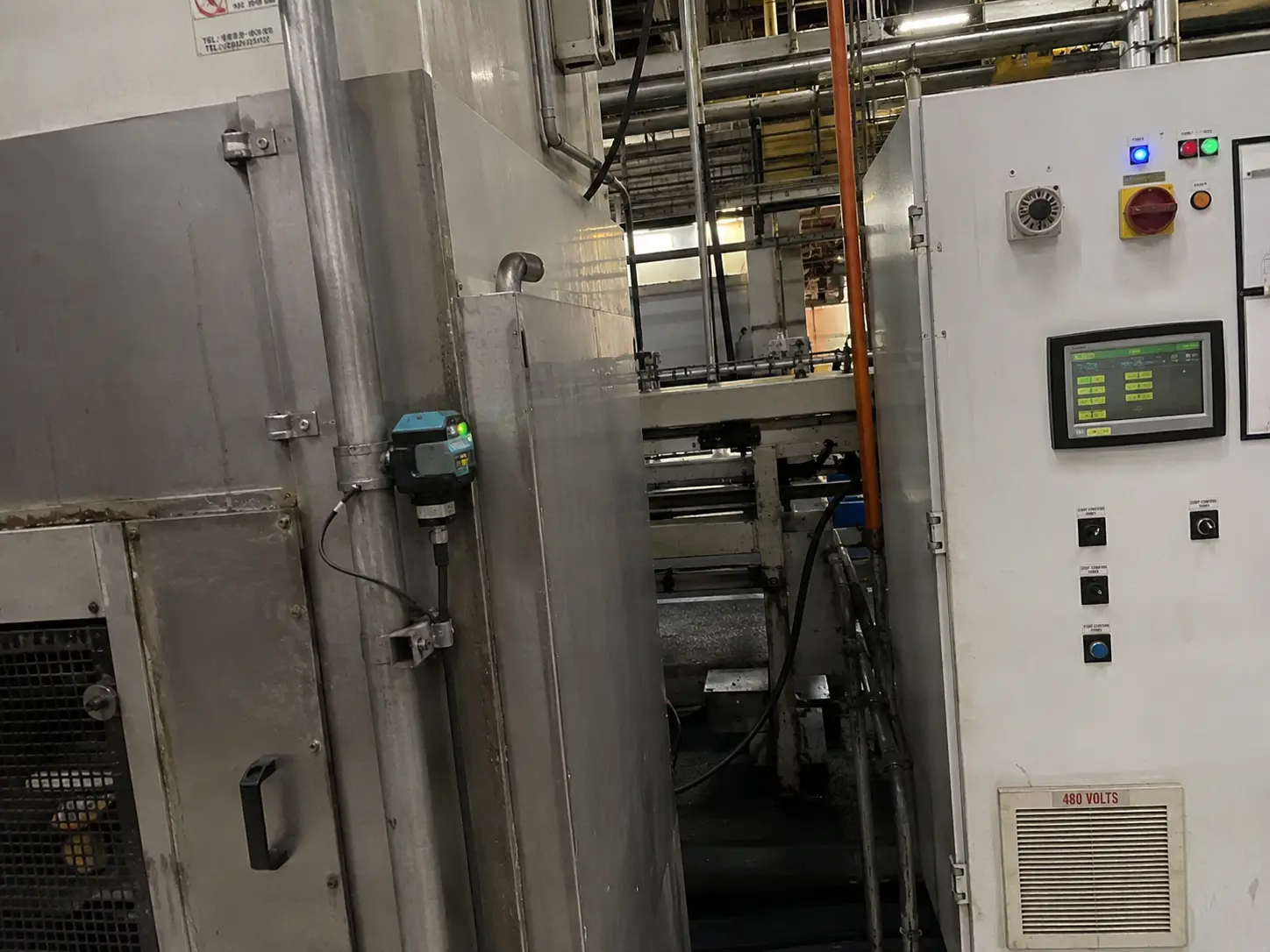
An Industrial IoT system starts from physical assets. Industrial sensors, machines, PLCs and embedded devices generate data on the performance of a process.
This data is transmitted through gateways, industrial networks and edge computing devices. Edge processing matters when certain decisions need to be made close to the machine, with low latency and reduced dependency on cloud connectivity.
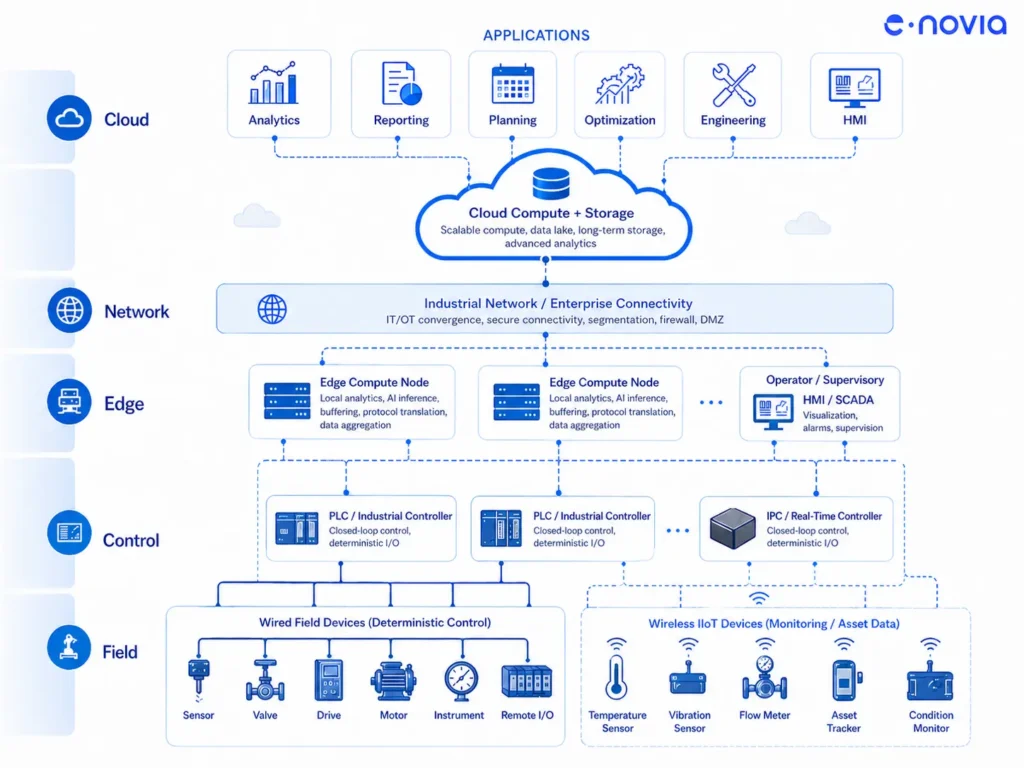
The IoT platform is the layer that makes data usable. Information from the field feeds dashboards, alerts, predictive models, enterprise system integrations and Physical AI applications.
Think.link, e-Novia’s modular IoT platform designed to integrate with AI, responds to this need. It connects industrial assets and systems while making data available for data-driven applications built around concrete use cases.
Value emerges when data does not remain confined to the platform. It becomes part of the operating flow across maintenance, quality, production, energy, service and product development.
Industrial IoT creates value when it makes complex, variable-dependent processes easier to govern.
In manufacturing, it enables companies to monitor plant status and identify anomalies before they lead to unplanned downtime. In maintenance, it supports the shift from reactive to predictive models. In energy-intensive contexts, it links consumption to production parameters and makes improvement areas more visible.
One relevant application is the digital twin. Data collected from physical assets can feed a digital representation of machines, plants or processes. This allows teams to observe system behaviour, assess scenarios and support more informed technical decisions. We explored this topic in our article on digital twin examples in manufacturing.
IIoT also enables new service models. A connected industrial product can become a continuous source of information on usage, operating conditions and customer needs. This creates opportunities for advanced maintenance services, performance optimisation and usage-based business models.
In one engagement with an energy-intensive manufacturing company, the priority was to make the relationship between production and energy consumption more transparent.
The company operated in a context where energy consumption depended on multiple operating conditions. The objective was not simply to visualise data. The objective was to support daily decisions on process settings, waste reduction and production performance.
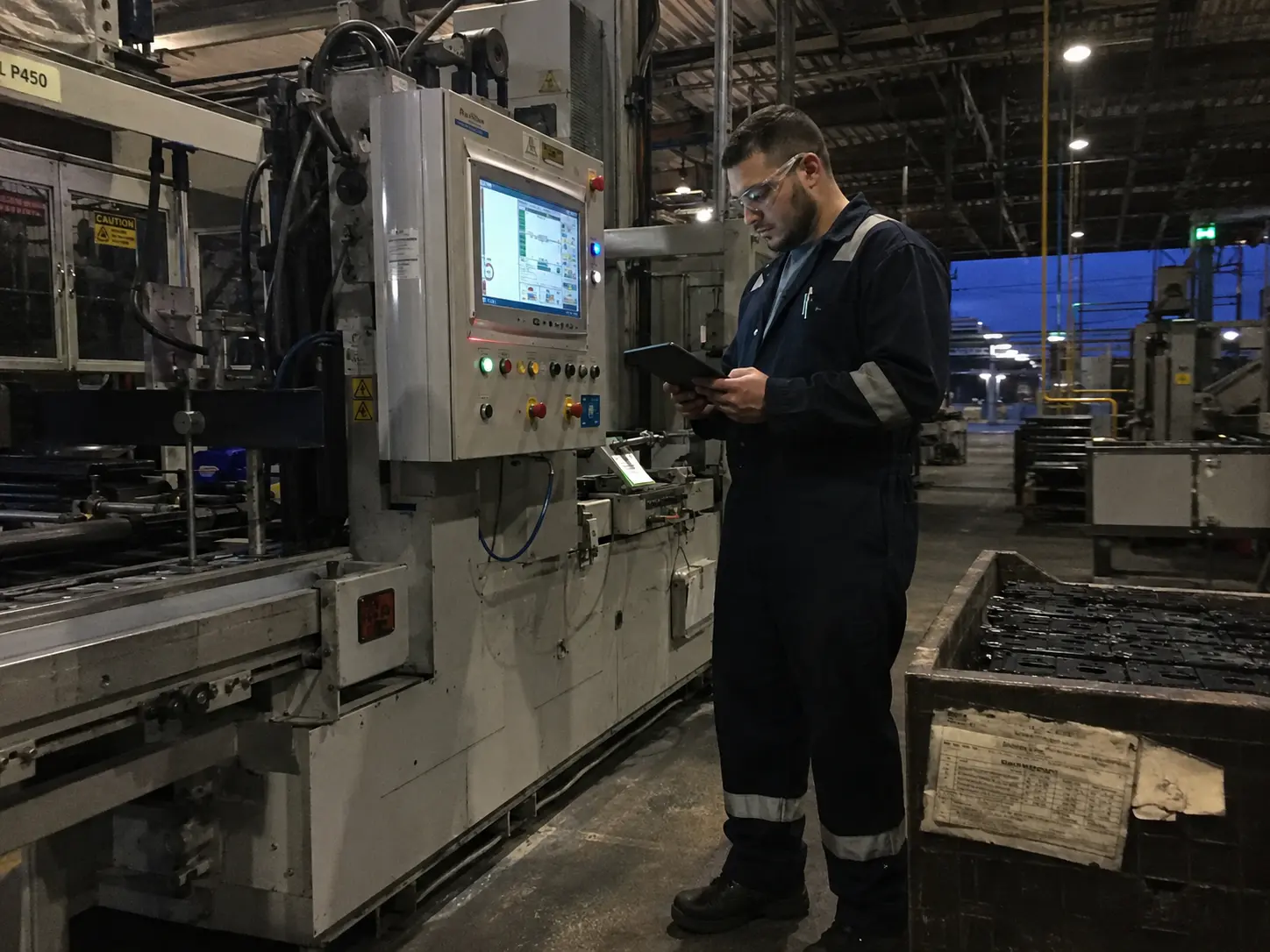
We developed a Decision Support System based on production data. The system helped operators and production managers identify relevant relationships between process parameters and energy consumption, turning data into operational recommendations.
This is a critical point. Industrial IoT creates value when it goes beyond dashboard logic and becomes part of how people work. Industrial data, by itself, does not improve a process. It becomes valuable when it reduces decision complexity and clarifies the next best action.
Industrial IoT is one of the technological foundations for bringing Physical AI into industrial processes.
IIoT makes data from the physical world available. Physical AI uses this data to improve the behaviour of products, machines and processes in their operating context. The distinction matters. This is not only about analysing information. It is about making industrial systems more adaptive, measurable and capable of supporting complex decisions.
Many companies already have sensors, connected machines and data platforms. The real challenge is turning this technology base into operational capability. The relevant question is not how much data is collected, but which decisions can improve and which processes can become more efficient.
When we work on Industrial IoT projects, we start from this perspective. We identify the anomaly to anticipate, the consumption to reduce, the activity to simplify or the decision to support. The technology architecture comes after the industrial objective is clear.
An effective Industrial IoT project does not start with platform selection. It starts with a relevant industrial problem.
The first step is to define the expected value. The objective may be to reduce downtime, improve quality, optimise energy consumption, increase traceability or enable a new digital service. Without a clear priority, the risk is to build a technically sound system that is not used at scale.
The second step is to assess data maturity. Companies need to understand which assets are already connected, which data is available, which systems need to interact and which constraints exist on the shop floor.
The third step is to validate the solution on a controlled scale. A well-designed pilot makes it possible to test data quality, technical integration, usability and operational impact. Scaling should come only after this validation.
The success of IIoT depends on the ability to connect technology and adoption. A solution that does not enter real business processes remains a digitalisation exercise. A solution that improves how people make decisions becomes competitive infrastructure.
Industrial IoT should not be understood as a connectivity project. It should be understood as a lever to improve the quality of industrial decision-making.
For manufacturing companies, this means building processes that are easier to read, assets that are more intelligent and operating models that are more responsive. The value does not come from technology alone. It comes from designing systems that fit the production context, the people who will use them and the economic objectives of the business.
Discover how we support industrial companies in turning data, machines and processes into intelligent systems through AI-ready IoT platforms, digital twins and Physical AI.