Urban Mobility Data: Why the Right Data Matters More Than the Volume
At Milan’s MOBIDAYS, Blimp shares how data helps identify where to act on urban...

Telerobotics is becoming increasingly relevant to the future of industrial robotics and Physical AI. Its value lies in a simple but powerful idea. A person can guide a robot from a distance while keeping human judgment at the center of the action.
This matters because many physical tasks still require human understanding. The challenge is that the operator and the robot are no longer in the same place. The robot acts in the physical world, while the person controls it from another location. That separation can improve safety and extend human capability, but it also creates a clear limitation. The operator can see what the robot is doing, but often cannot feel what the robot is touching.
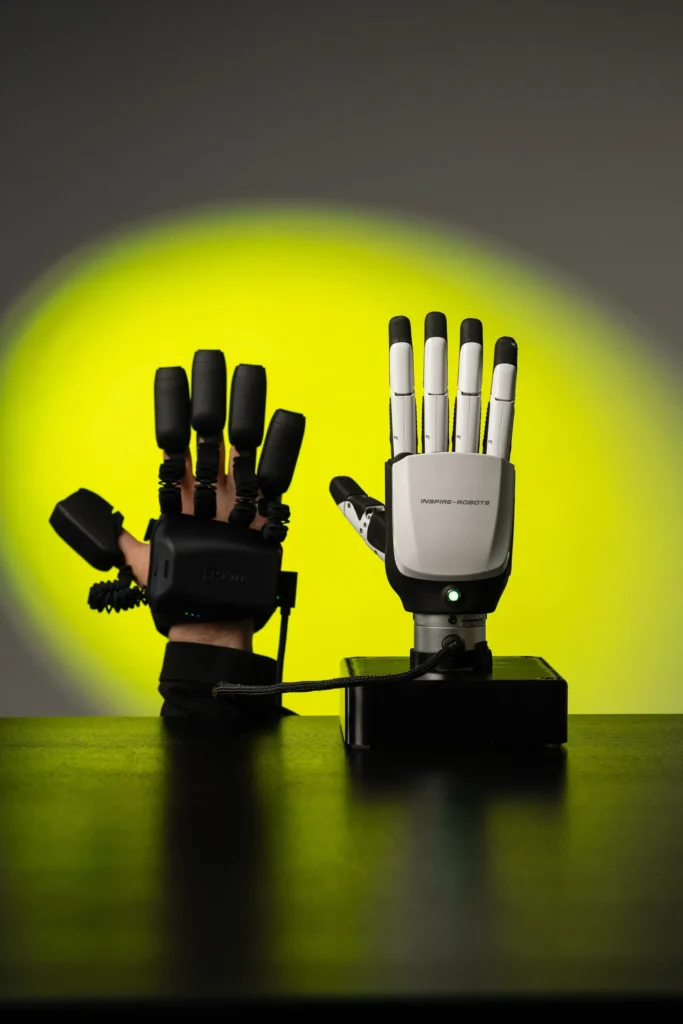
With the new application of TouchDIVER Pro for robotic teleoperation, Weart, a company within the e-Novia Venture Studio, addresses one of the long-standing constraints of remote robotics. In many traditional systems, feedback to the operator is mainly visual. When the robot touches an object, the user may struggle to understand the quality of that contact.
Haptic feedback in telerobotics changes this relationship. Through the TouchDIVER Pro haptic glove, the operator can control a robotic hand and receive real-time tactile feedback on the fingers and palm. This allows the user to perceive contact, assess the stability of a grasp and adjust the applied force with greater confidence.
Telerobotics refers to the technologies that allow a person to control a robot remotely. Unlike conventional automation, where a machine executes predefined instructions, robotic teleoperation keeps the operator actively involved in the process.
This approach becomes valuable when a task still requires human judgment, while direct human presence is difficult or unsafe. It can apply to industrial environments that are hard to access, to hazardous operating conditions or to activities where safety requires a different model of work.
The value of telerobotics is not simply distance. Its real value is the ability to make distance less limiting. The more clearly the operator understands what the robot is doing, the more effective remote control becomes.
Many robotic teleoperation systems are built around a visual interface. The operator observes the scene through a camera and sends commands to the robot. This model can work for linear tasks, but it becomes weaker when the robot needs to interact physically with the environment.
A camera can show that a robotic hand has reached an object, but it may not reveal the quality of the contact. It can show a grasp that looks correct, while failing to make clear whether the object is slipping. It also cannot always convey information that matters during manipulation, such as resistance or surface behavior.
Without haptic feedback, the operator must infer these signals indirectly. This increases cognitive load and makes the gesture less natural. In telerobotics, touch is not an accessory. It is operational information.
Haptic feedback in robotic teleoperation allows the system to return a physical sensation connected to what the robot encounters. When the robotic hand touches an object, the glove transmits a tactile response. When the grasp changes, the sensation returned to the user changes as well.
With TouchDIVER Pro, Weart works on bidirectional haptic interaction. The operator controls the robotic hand through their own hand movement, while the system sends tactile information back through the haptic glove.
This real-time exchange brings telerobotics closer to the natural experience of human action. When people interact with an object, they do not rely on sight alone. They use touch to understand contact and adapt movement. Bringing this logic into remote robotics makes human-machine interaction more immediate.
The new TouchDIVER Pro application is built on a modular software stack that connects the haptic glove to a robot or to a simulation environment. The device captures the movement of the operator’s hand and translates it into robotic commands in real time.
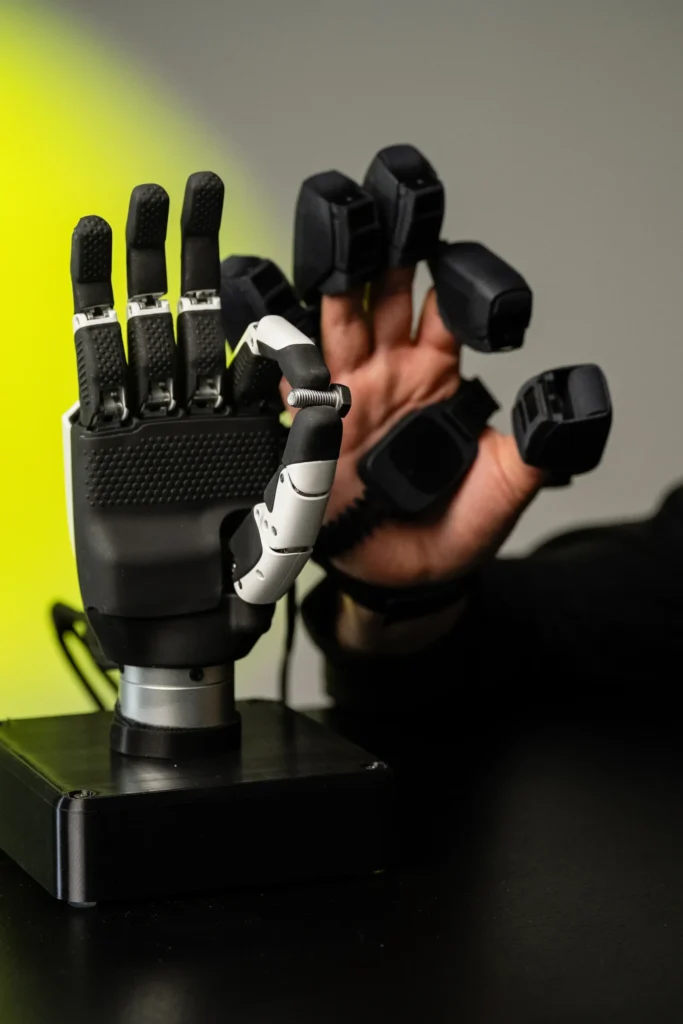
The system is based on WEART-Core, a Linux middleware that manages the communication layer, and on a modular ROS2 architecture. This architecture separates motion control from haptic feedback, allowing each layer to be adapted without redesigning the entire system.
When a new robot is connected, only the hardware-specific remapping layer needs to be adjusted. The rest of the stack remains stable. This makes TouchDIVER Pro more flexible when integrated with different robotic systems.
The full loop can also be validated in simulation before moving to real hardware. For robotic teleoperation, this means teams can test the system in a controlled environment and reduce risk before physical deployment.
Telerobotics has clear potential for industrial robotics, particularly in contexts where companies need to improve operational safety while maintaining human control over critical tasks.
Remote robotics can support interventions in difficult environments and reduce human exposure to complex conditions. It can also allow specialist expertise to be applied at a distance, without requiring the operator to be physically present where the action takes place.
Haptic feedback expands this potential because it makes teleoperation more informed. The operator does not only observe the robot’s action. They receive physical information that helps them decide how to act during the task.
For companies, this opens a different operating model. The machine acts in the physical environment, while the person remains central to evaluation and control. This is closely aligned with e-Novia’s work on Human Augmentation and Venture Studio Physical AI.
Telerobotics is relevant whenever an action must be controlled remotely and direct human presence is not possible or advisable. When the task requires precision in manipulation, haptic feedback can change what is realistically achievable from a distance.
In industrial robotics, robotic teleoperation can support the remote handling of components in constrained or hazardous environments. In these scenarios, a camera alone may not be enough to understand whether the robot has established the right contact with an object.
Tactile feedback gives the operator a physical confirmation of the interaction. This can make control more deliberate and reduce dependence on visual interpretation alone.
In medical robotics, telerobotics can enable procedures where human control remains central but is transferred through a robotic system. In this context, haptic feedback can help the operator better perceive the force being applied.
The value becomes particularly important when too much or too little pressure can affect the quality of the procedure. Tactile feedback does not replace professional expertise. It gives that expertise a stronger channel in remote control.
Telerobotics can also play an important role in the development of embodied AI systems. When an operator guides a robotic hand through a haptic interface, the system can collect high-fidelity human demonstrations.
These data can help train robotic systems to better understand the relationship between gesture and physical outcome. From this perspective, the haptic glove is not only a control device. It becomes a channel for transferring human know-how into more advanced robotic models.
In research settings, robotic teleoperation can accelerate the validation of new manipulation tasks. The ability to test the full loop in simulation before using real hardware makes the process more controlled.
This is useful when a team needs to understand whether a control strategy is effective or whether the interface gives the operator enough information to act. In this sense, TouchDIVER Pro can support a more solid transition from experimentation to physical validation.
The new TouchDIVER Pro application shows how haptic feedback can make telerobotics closer to the way people naturally interact with the physical world. The point is not only to command a robot from a distance. It is to give the operator back part of the sensitivity that is usually lost when action is mediated by a screen.
For e-Novia, this is a concrete example of Physical AI in practice. Intelligence does not remain confined to software. It enters a relationship with physical systems and human interfaces. This is where robotic teleoperation can become a more effective bridge between people and machines.
For more information on the new TouchDIVER Pro application in robotic teleoperation, read the official Weart article.