Building Physical AI ventures at e-Novia Investor Day
How e-Novia’s Physical AI Investor Day connected startups with investors and industry...

In the world of innovation, the problem is rarely a scarcity of ideas. The real challenge lies in the ability to take an intuition from the lab and transform it into a solution that operates reliably and at scale in the real world.
Europe boasts recognized excellence in basic scientific research. In sectors such as robotics, med-tech, and advanced materials, we possess solid technologies, often already tested at the prototype level. However, too many of these innovations never reach the market or arrive when the window of opportunity has already closed. To bridge this gap, the Venture Building model acts as an organizational and technical infrastructure capable of transforming knowledge into tangible value.
A technology can be flawless in a controlled environment, but that does not automatically make it a product. There is an intermediate space, often critical, that requires skills radically different from academic ones: product engineering, process industrialization, intellectual property management, and robustness verification in real-use contexts.
This phase of “industrial grounding” requires a methodical process of simplification and validation. Many systems that are revolutionary in the lab fail because they lack the structure necessary to make them scalable. Venture Building intervenes in this “no man’s land,” providing the method to transform complex systems into market assets ready for industrial integration.
Unlike traditional acceleration models, the e-Novia Venture Studio operates as an orchestrator of multidisciplinary skills. The approach does not start from abstract suggestions but from technological evidence that requires industrial translation.
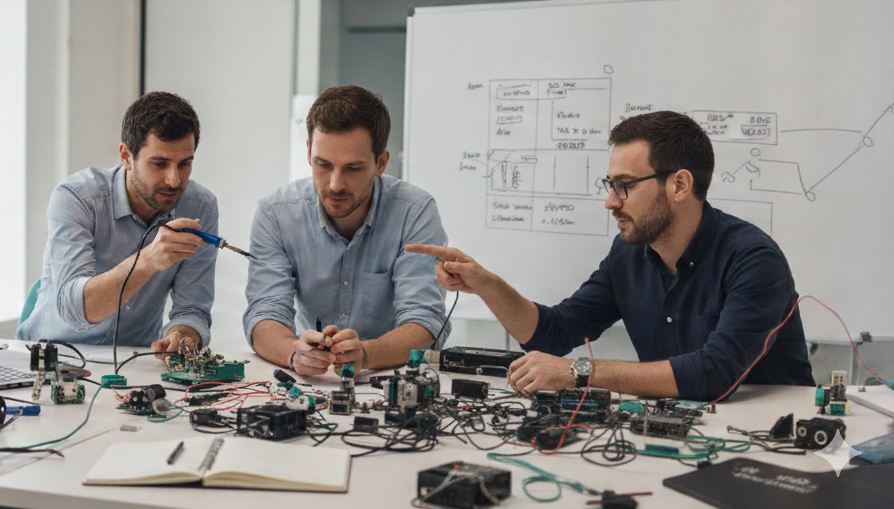
In this model, support for researchers and founders translates into providing vertical professional expertise: from hardware and firmware development to mechanical and algorithmic engineering. The Venture Studio acts as an ecosystem enabler, bringing industrial partners, investors, and specialized operators to the table from the early stages. Collaborating among these actors allows for the integration of specific assets, production capacity, commercial channels, or vertical technical skills, already during development, reducing time-to-market and operational risks associated with technological complexity.
When software and algorithms meet the physical world, the complexity of the project increases exponentially. Integrating sensors, actuators, and computational logic requires a synergy across different disciplines that an isolated startup rarely possesses. In this context, Physical AI is not just a technological category but represents the challenge of transforming intelligent systems into robust and certifiable industrial products.
The Venture Studio provides the environment needed to manage this complexity, ensuring that the artificial intelligence component is natively integrated with the product’s physical structure, guaranteeing the performance and reliability required for the industrial and consumer markets.
The value of this method emerges in the journeys of companies that have completed or are currently undergoing the transition to the market. Ars Bionica represents the most recent case of a company entering the e-Novia Venture Studio ecosystem. Born from over ten years of activity at the Rehab Technologies Lab (a joint lab between IIT and INAIL), Ars Bionica develops advanced prosthetic devices. In this journey, the Venture Studio supports the co-founders to accelerate the industrialization of solutions born in a research environment, transforming scientific potential into a scalable product ready for healthcare systems.

A consolidated example of the model’s effectiveness is the experience of Blubrake, a company specialized in ABS systems for e-bikes and micromobility. Blubrake represents a successful exit for the Venture Studio, having reached a position of technological leadership that allowed it to attract top-tier investors. Its growth and the subsequent sale of the stake demonstrate how the synergy between engineering and industrial vision can generate high-value assets capable of competing in global markets.
Building industrial competitiveness
Competitiveness today is played out on the ability to transform knowledge into value quickly. An innovation ecosystem is effective only if it eliminates the gray areas between scientific publication and industrial application.
It is not enough to fund technology; it is necessary to build the methodical path that leads it to the market. Venture Building represents this necessary condition for excellence in research to translate into economic progress, social impact, and technological sovereignty.
👉 Find out how e-Novia supports companies and researchers in adopting Physical AI technologies.