Urban Mobility Data: Why the Right Data Matters More Than the Volume
At Milan’s MOBIDAYS, Blimp shares how data helps identify where to act on urban...

While supply chain strategies are highly optimized, the ultimate logistical challenge lies in the final stretch: the journey from the distribution hub to the consumer.
With the explosion of e-commerce, last-mile delivery has become the critical point of urban operations. Traffic congestion, environmental regulations, and rising costs mean this final leg can account for over 50% of the total delivery expense. As highlighted in a recent Forbes analysis, the last mile is the ultimate testing ground for technological innovation.
To meet these challenges, we at e-Novia promote a data-driven, collaborative approach between technology partners and institutions. Let’s explore the innovations reshaping this sector and how we put them to the test in a real-world ecosystem.
Four fundamental macro-trends are currently driving global investment toward efficiency and sustainability:
The real breakthrough happens when these technologies work within a single ecosystem. This is the goal of GREEN-LOG, a European project designed to accelerate the transition to zero-emission urban logistics.
Within this international framework, e-Novia played a key operational role by managing and coordinating the tests at the Ispra Living Lab, located on the European Commission’s JRC (Joint Research Centre) campus. In this open-air laboratory, we turned theoretical logistics trends into operational reality, successfully completing two full demonstration cycles.
A core component of the trial was the technology provided by YAPE, a group company specializing in autonomous driving software for off-highway vehicles.
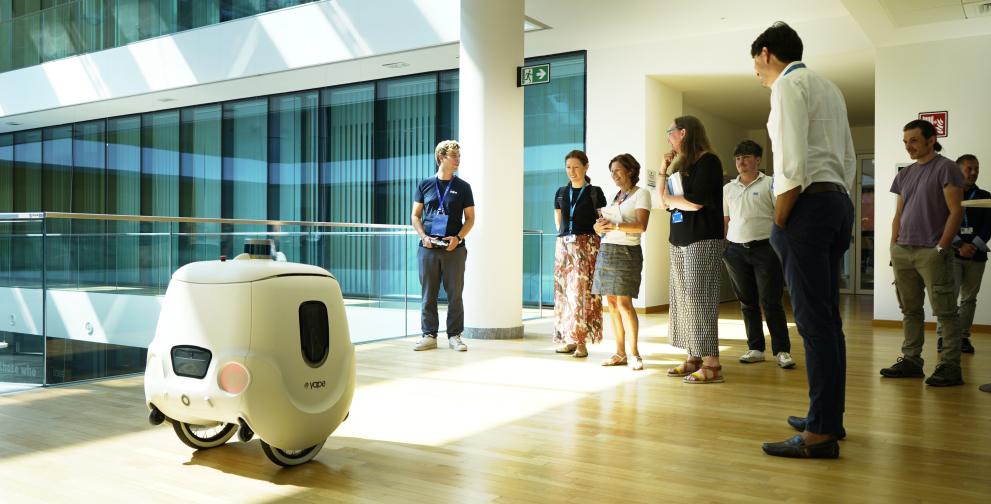
At the Ispra Living Lab, we demonstrated how our Physical AI vision addresses logistical hurdles:
At e-Novia, a “human-centered” approach is not an abstract concept, but a measurable metric. The true adoption of a new logistics technology is determined in the field by analyzing real behaviors. For this reason, at the Ispra Living Lab, we structured a rigorous quantitative and qualitative analysis based on surveys divided into two phases (Phase 1 completed between October and November 2025, Phase 2 currently ongoing).
We didn’t just test the autonomous driving software: we mapped sociodemographics, awareness levels, and user attitudes. Thanks to the data collected across 7 delivery points (6 buildings and 1 strategic aggregation point), we accurately tracked the preferred day of the week, the most utilized time slots, and the order volumes per building.
Most importantly, we were able to analytically compare the pre-pilot baseline experience—the traditional manual collection of meals at the canteen—with the overall evaluation of the autonomous droid delivery service. These operational insights, combined with the final CO₂ reduction calculations and the environmental impact report, provide the KPIs needed to certify actual user satisfaction and assess the project’s scalability for future deployments.
👉 Want to dive deeper into the technical results? Watch the video lecture led by our experts.