Building Physical AI ventures at e-Novia Investor Day
How e-Novia’s Physical AI Investor Day connected startups with investors and industry...

“I have this idea, but I never have the time to properly explore it.”
It is a recurring observation among executives and research and development teams. It does not reflect a lack of vision, but a very specific organizational dynamic: the urgency of day-to-day operations absorbs attention and slows the development of new initiatives. Organizations, especially those focused on protecting and optimizing their core business, naturally resist the introduction of additional complexity.
Yet in markets where hardware and software are rapidly converging and redefining entire industries, the opportunity cost of postponing technological innovation continues to rise. Maintaining the status quo may appear to be the safest short-term choice, but over time it can gradually erode competitive positioning. The real managerial challenge therefore becomes far more pragmatic: understanding how to move from an unstructured intuition to a governable and measurable process.
Preventing ideas from remaining trapped in theoretical presentations or being absorbed by operational priorities requires addressing several structural frictions.
The first challenge is organizational. Innovation requires strong internal alignment. When key stakeholders perceive a new technological initiative as an unsustainable workload or a distraction from primary objectives, projects struggle to gain traction from their earliest stages. Overcoming this barrier requires an approach capable of integrating new solutions smoothly into existing operations while demonstrating the long-term value of the investment without compromising operational stability.
There is also a challenge directly related to technology adoption. Bringing artificial intelligence, advanced sensing technologies or mechatronics into a physical product requires highly specialized expertise that rarely exists entirely within a single organization. This is often where the real gap emerges between a promising proof of concept and a scalable industrial solution capable of reaching production lines or commercial markets.
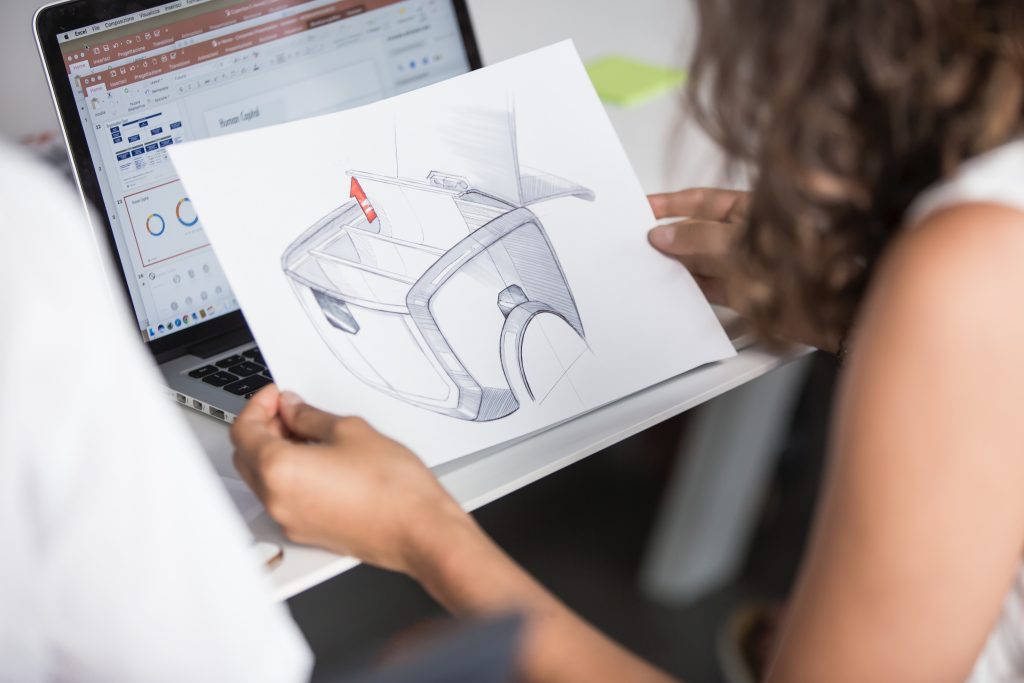
Bridging this gap is fundamentally a matter of methodology. Exploratory sessions and innovation workshops, while useful, are rarely sufficient to generate deployable products. Turning a vision into an executable project requires a rigorous framework capable of validating technological assumptions, defining system requirements and estimating return on investment.
Without a structured de-risking process, development timelines expand through inefficient iteration cycles and budgets progressively lose effectiveness.
Some companies choose to manage this transition internally by strengthening their research and development departments. However, there is another equally solid model, particularly common in more traditional industrial sectors, in which organizations prefer to remain focused on their historical core competencies while collaborating with specialized external partners.
Within this collaborative space, e-Novia supports companies throughout their technological and strategic evolution, intervening selectively at both product and process level.
Observing these dynamics from within industrial processes reveals a consistent pattern: technological opportunities and intuitions are often abundant. The real challenge is not generating ideas, but selecting the right ones.
Building a strong innovation strategy therefore becomes the essential first step in identifying where investment can generate meaningful value.
To support this exploratory phase, we structure different types of innovation paths, selecting the format best suited to the company’s starting point and the specific challenge being addressed. Yet conceptual validation alone is only one part of the equation.
The real difference between a theoretical exercise and a sustainable competitive advantage lies in the ability to move beyond strategic discussions and into actual implementation. Our approach is designed to ensure continuity from strategic ideation to technological execution, transforming early-stage intuitions into deployable business models and industrial solutions.
In some cases, this process enables companies to expand far beyond the boundaries of their traditional markets.
This is precisely what happened with Agrati Group, a global leader in fastening systems. Starting from the need to explore new technological opportunities, an intensive validation process conducted together enabled the identification of an unmet need within the structural monitoring sector. This technical and commercial exploration eventually led to the creation of Tokbo, a joint venture focused on intelligent fastening systems for infrastructure monitoring.
The case demonstrates the value of a coherent methodological approach: an initial intuition was decoded and transformed into an entirely new company, generating both a new product category and a revenue model beyond the organization’s traditional core business.
Ultimately, innovation is not primarily a matter of available time, but of method and prioritization.
In rapidly evolving industrial ecosystems, the greatest risk often lies not in exploring new technologies, but in remaining static while markets redefine their standards. Structuring a strategic innovation pathway means moving beyond the constant pressure of operational urgency and beginning to build, with clarity and technical rigor, a company’s future competitive positioning.