Rapid Prototyping: The Strategic Accelerator for Industrial Innovation
Discover how rapid prototyping and Physical AI reduce investment risks in product dev...

Every year, international research firms publish forecasts on the technologies expected to shape the future: artificial intelligence, cloud, robotics, automation. The keywords do not change much.
What really changes is the moment when these technologies begin to generate concrete effects in industrial systems.
2026 appears to mark exactly this transition. Not because an entirely new technology is emerging, but because many already familiar technologies are finally moving beyond experimentation and into production systems, industrial products and critical infrastructure.
In recent years, digital investment in Italy has continued to grow. Italian companies’ ICT budgets are expected to increase by 1.8% compared with 2025, while 86% of large companies have already launched open innovation initiatives to accelerate the adoption of new technologies.
At the same time, a very clear pattern is emerging: many companies no longer struggle to imagine technology use cases, but they still find it difficult to turn pilots and prototypes into scalable industrial applications.
Looking at the industrial projects and deep tech startups we work with at e-Novia, five directions are already redefining the relationship between technology and industry.
In recent years, artificial intelligence has been associated mainly with software.
In 2026, that picture is expanding.
AI is beginning to enter the physical systems that make up industrial infrastructure. Machines, infrastructure and technical devices are becoming systems capable of observing how they operate, interpreting data and supporting operational decisions.
This shift is often described as Physical AI.
It is not simply a matter of applying algorithms. It means integrating sensing technologies, data infrastructure, analytical models and operational decision-making directly into physical systems.
At e-Novia, this is exactly the kind of integration we work on: where digital technologies and engineered systems converge to create new products and industrial services.
For a country like Italy, where a large share of economic value still depends on manufacturing and industrial components, this transition could have a particularly significant impact.
A second transformation concerns the nature of industrial products themselves.
For decades, the value of a component was determined almost entirely by its mechanical or functional characteristics.
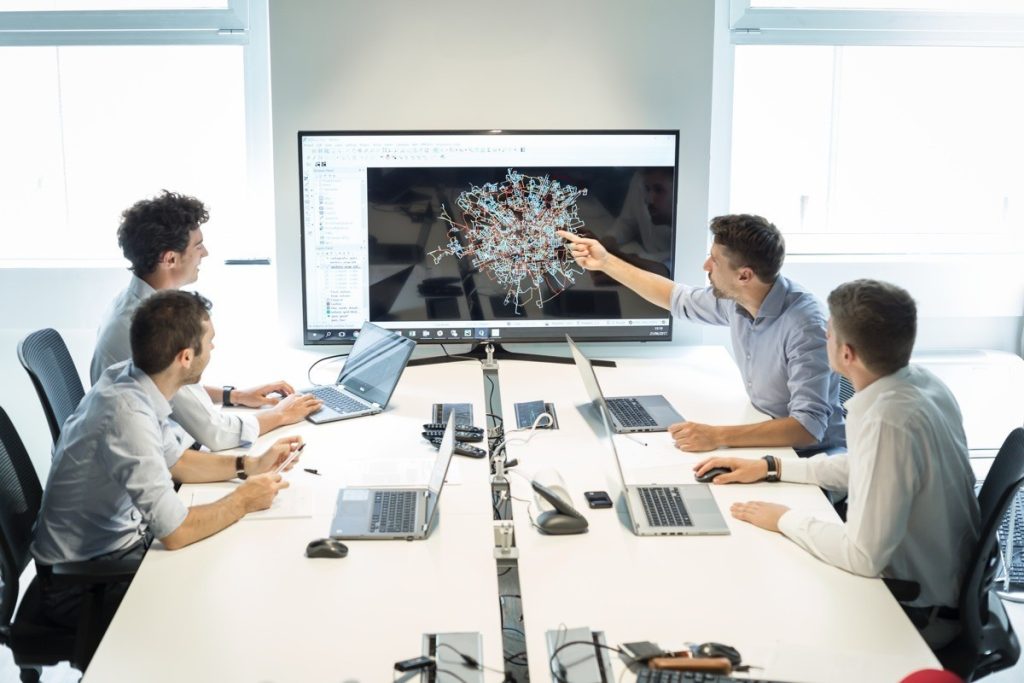
Today, many products are becoming distributed information systems.
Through sensors and connectivity, products can generate data about how they perform in real operating conditions. This means that value no longer ends with the physical object itself.
It extends into digital services such as remote monitoring, predictive maintenance, asset management and performance optimization.
A concrete example of this evolution is Tokbo, the smart bolting system we developed at e-Novia together with Agrati to monitor the condition of structural connections in infrastructure.
In this way, a traditional mechanical component also becomes a source of operational intelligence.
Many industrial AI applications do not start in the cloud.
They start close to the machines.
Distributed sensors, IoT devices and edge computing make it possible to collect and analyze data where it is generated. This is especially important when systems need to react quickly, data volumes are high and network latency becomes critical.
For this reason, technology architectures are evolving toward distributed models that combine cloud, edge and field devices.
To support the implementation of these infrastructures, at e-Novia we developed Think.Link, an IoT platform designed to connect sensors, industrial devices and digital systems, simplifying the collection and analysis of asset-generated data.
These infrastructures often remain invisible, but they are one of the key prerequisites for bringing AI into industrial systems at scale.
For many years, digital transformation was associated primarily with process automation.
Today, a new phase is emerging.
The operating systems of organizations are becoming adaptive.
The data generated by machinery, products and infrastructure is no longer used only for retrospective analysis. It can now support operational decisions in near real time.
This is enabling new management models: maintenance based on actual asset conditions, continuous optimization of production processes, operational infrastructure monitoring and dynamic supply chain management.
In many cases, these applications are also linked to industrial policy.
Italy’s Transition 5.0 Plan, for example, requires companies to certify energy consumption reductions both before and after project implementation in order to access tax incentives. This is pushing many businesses to adopt advanced sensing and energy monitoring systems.
A final shift concerns how new technologies reach the market.
More and more innovations are emerging at the intersection of scientific research, deep tech startups and industrial companies.
Technologies such as advanced robotics, smart sensing and applied AI require capabilities that rarely exist within a single organization.
That is why innovation models based on ecosystems are becoming more important.
At e-Novia, we see this change firsthand through the work of our Venture Studio. By connecting entrepreneurs, universities, industrial partners and investors, we help high-potential ideas move from concept to market.
From day one, we work alongside researchers, founders, industrial players and financial stakeholders to transform promising technologies into fundable and scalable startups.
In this sense, innovation does not come only from adopting new tools. It comes from building the industrial, technological and entrepreneurial conditions that allow those technologies to become real businesses.
For many Italian companies, these trends may still seem distant.
In reality, their implications are highly concrete.
Italy’s industrial system is largely made up of manufacturing companies and complex production supply chains. These are precisely the environments that can benefit most from the integration of physical systems and digital technologies.
There are at least four strategic implications.
Increasingly, value will be generated by the ability to collect and interpret data from machinery, products and infrastructure.
Many manufacturing companies are beginning to offer digital services connected to their products.
More and more companies are working with startups, universities and research centers to accelerate the adoption of deep tech technologies.
The most important change is not the introduction of a single technology. It is the ability to integrate multiple technologies within complex industrial systems.
Taken together, these trends point in a clear direction.
Technology innovation is no longer confined to the digital world alone.
It is increasingly about the convergence of artificial intelligence, sensing technologies, data infrastructure and industrial systems.
Machines, products and infrastructure are becoming more intelligent, more connected and more capable of generating data.
A large share of the innovation of the coming years will emerge from this convergence.
And for a country like Italy, where industry and manufacturing remain central to the economy, this could become one of the most important drivers of technological transformation in the next decade.