logo
logo

The Evolution of Industrial Data: From IoT Collection to Strategic Action with Physical AI

Date
31 March 2026
Author
e-Novia Editorial Team
Share

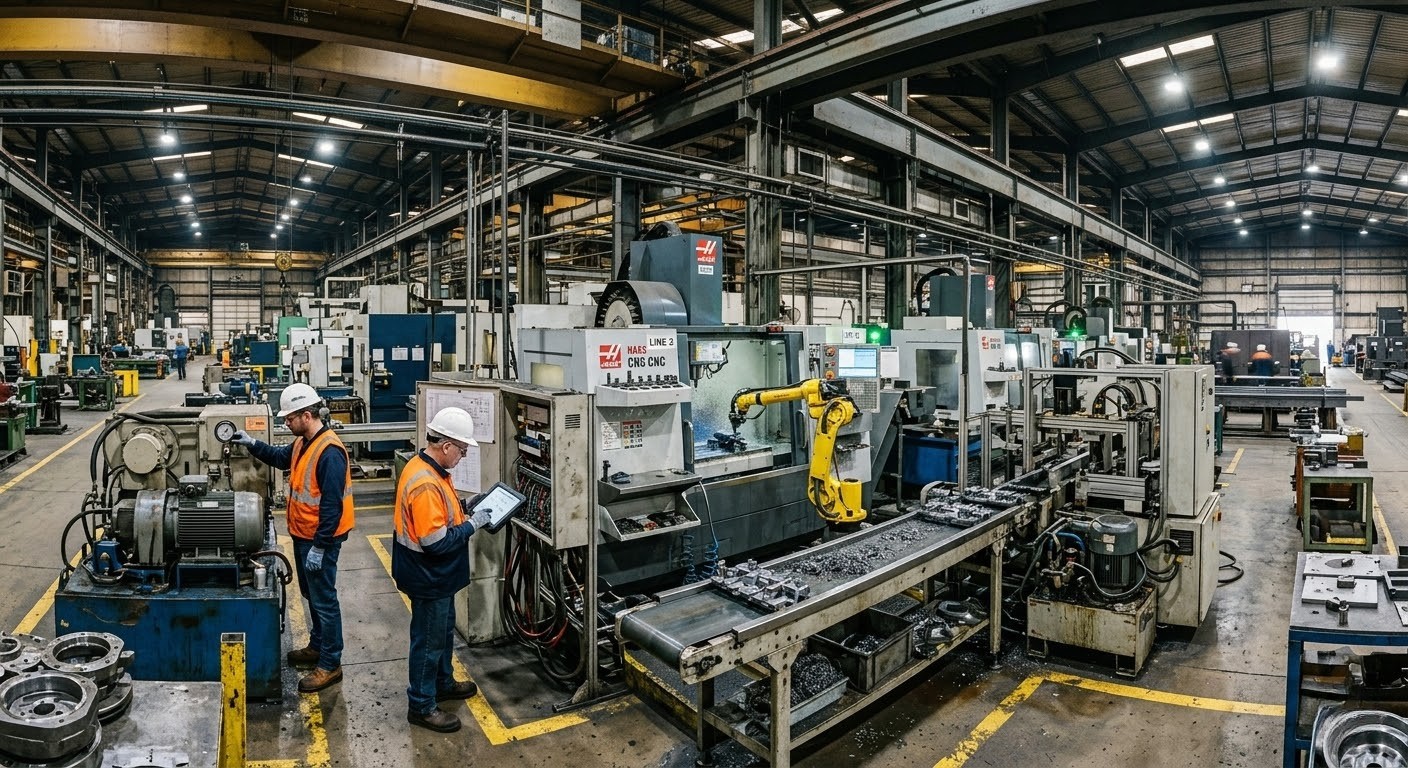
The widespread adoption of connected technologies on the factory floor has generated an unprecedented amount of data. Today, industrial leaders know that the real competitive challenge is no longer just connecting machines, but strategically decoding the information they produce. If treated merely as a historical archive, data is just a storage cost. However, when transformed into actionable insights in real time, it becomes the main driver of Operational Excellence.

In this scenario, the transition from basic Internet of Things (IoT) to the application of Physical AI draws the line between companies that struggle with technological complexity and those that master it to generate measurable value.

1. The Information Overload and Data Collection


The starting point of any digital transformation is capturing data directly from the shop floor. Historically, manufacturing processes relied on manual tracking, which today has naturally evolved into digital data entry via mobile devices. While using tablets reduces delays compared to paper, it still has a major structural limit: it relies on human action. This exposes the process to delays, missing information, and micro-inefficiencies.

Achieving true technological maturity requires an automated architecture. Deploying an industrial IoT network is not just a hardware installation; it is a complete redesign of the information flow. It involves key strategic steps:

  • Goal Assessment: Identifying upfront which metrics drive business value (e.g., machine utilization, quality deviations, energy consumption).
  • Sensing Infrastructure: Deploying sensors and edge devices calibrated to continuously capture specific physical metrics (vibrations, thermal changes, flows) without interrupting the workflow.
  • IT/OT Integration: Building a seamless bridge between the operational level (machines, sensors) and the management level (ERP, Business Intelligence systems).

This level of automation eliminates human error and provides an exact map of the factory’s reality. Yet, simple telemetry is not enough to make complex decisions.

2. Physical AI: The Engine of Operational Excellence


Where basic connectivity stops, intelligent orchestration begins. Physical AI steps in to analyze terabytes of raw data and identify patterns that are invisible to human observation or traditional control systems.

Applying Machine Learning (ML) and Deep Learning (DL) models to IoT data means shifting from a reactive approach to a proactive strategy. This directly impacts three core areas of Operations:

  • Predictive Maintenance: Continuous monitoring of asset health (Condition Monitoring) allows algorithms to recognize degradation patterns. A neural network can detect a micro-vibrational anomaly and calculate the Remaining Useful Life (RUL) of a critical component. The result is a drastic reduction in unexpected downtime and optimized maintenance costs (Opex).
  • Proactive Quality Control: Using supervised learning models, AI analyzes process variables (like temperature or pressure fluctuations) in real time. The system can predict a drop in quality standards before a production batch is finished, allowing for on-the-fly corrections and cutting costs related to waste and non-compliance.
  • Production Optimization: A highly promising area is applying AI to production planning and control. This includes balancing lines, reducing idle time, and optimizing operating parameters based on continuous self-adaptation, ensuring the highest Overall Equipment Effectiveness (OEE).

3. Beyond the “Black Box”: The Need for Explainable AI


Integrating advanced algorithms into decision-making raises a critical issue for plant managers: the problem of transparency, often called the “Black Box” dilemma.

Highly complex predictive models can provide accurate warnings (e.g., “The machine will fail in four hours”), but they often cannot explain the logical reasons behind the prediction. In an industrial setting, this is unacceptable. Organizations driven by Continuous Improvement principles need not only to anticipate a problem but to understand its root cause (Root Cause Analysis).

To mitigate this risk and encourage real technological adoption, innovation consulting is shifting toward Explainable AI. This approach works in two ways:

  1. Inherently transparent models (Ante-hoc): Using algorithms with a clear logical architecture that engineers can easily read, making it simple to spot parameters that are out of bounds.
  2. Post-interpretation techniques (Post-hoc): Applying statistical frameworks to complex models to “light up” the black box, measuring the specific impact of each individual sensor (feature importance) on the predicted event.

Only interpretable AI allows operators to trust machines and empowers decision-makers to turn a technical anomaly into a strategic process review, closing the loop of value creation.

4. Method, Technology, and Vision: The Architectural Approach


Digital transformation cannot be bought off the shelf; it must be designed. For the integration of IoT hardware and Artificial Intelligence to generate a real, measurable financial return, an open, modular, and action-oriented architecture is required.

This is exactly why we developed Think.Link at e-Novia: an AI-ready IoT architecture designed to break down information silos, connect diverse data sources, and make data immediately usable as practical suggestions for operational teams.

The success of an Industry 5.0 initiative lies in the ability to combine the strategic analysis of business processes with end-to-end technological execution. At e-Novia, we shape the innovation born from research, working alongside companies to ensure that every newly installed sensor and every trained algorithm translates into a solid competitive advantage on the market.

👉 Discover how e-Novia supports companies in the strategic adoption of Physical AI technologies to build new competitive advantages.

Our news

analisi-dati-IoT-manifattura

The Evolution of Industrial Data: From IoT Collection to Strategic Action with Physical AI

The widespread adoption of connected technologies on the factory floor has generated an unprecedented amount of data. Today, industrial leaders...
Workshop

Technological Innovation and Operational Overload: Transforming Intuition into a Strategic Asset

“I have this idea, but I never have the time to explore it.” This remark is frequently heard within the C-suite and R&D depa...
Robot a guida autonoma YAPE utilizzato come dimostratore Physical AI e media digitale per Adtech

The Convergence of Physical AI and Marketing: The Case of Media Robots

The evolution of contemporary marketing strategies is leading to a progressive blurring of the boundaries between digital space and the physica...
Ars-Bionica-entra-nelle-Novia-Venture-Studio

From research to enterprise: Ars Bionica joins e-Novia’s Venture Studio

Ars Bionica joins the e-Novia ecosystem, marking a new step in the journey from scientific research to industrial venture creation. The comp...
joshua-sortino-LqKhnDzSF-8-unsplash-scaled

The 5 Technology Innovation Trends Shaping Italy in 2026

From AI-powered products to intelligent infrastructure Every year, international research firms publish forecasts on the technologies ex...
Sistema di manutenzione predittiva con sensori industriali e analisi dei dati

How to Implement Predictive Maintenance in Industrial Assets

In today’s industrial environment, maintenance can no longer be treated as a function separate from asset management. It directly affects produ...
Fabbrica 5.0: Physical AI per qualità, manutenzione ed energia

AI Governance in Companies: Why It Has Become a Leadership Imperative

Artificial intelligence has moved quickly from experimentation to practical deployment. Over the past few years, companies across industries ha...
Servitizzazione: trasformare prodotti intelligenti in servizi scalabili

Servitization: unlocking new revenue streams with Physical AI

For many industrial companies, servitization is becoming a positioning choice before it is a commercial model. It is not simply about attaching...