Process innovation: how to transform industrial production in 2026
For decision-makers and plant managers, process innovation represents the fundamental strategic asset to ensure the long-term competitiveness a...

Artificial intelligence has moved quickly from experimentation to practical deployment. Over the past few years, companies across industries have launched pilots, proof-of-concept initiatives, and exploratory programs to understand the potential of AI.
Yet for many organizations, the transition from experimentation to real transformation remains unfinished.
Many companies say they already use AI. But a closer look at actual use cases often tells a different story. In many cases, adoption remains limited to narrow applications with little impact on core business processes. The result is a growing gap between the perception of AI adoption and its actual strategic impact.
Bridging that gap requires more than deploying new technologies. It requires governance.
The real challenge today is not simply adopting artificial intelligence, but integrating it into corporate strategy—defining priorities, responsibilities, and decision frameworks that allow AI to create measurable value for the business.
Over the past decade, AI has entered organizations through a series of targeted initiatives: automating repetitive tasks, supporting decision-making, improving forecasting, or enabling digital assistants.
Many of these initiatives deliver incremental benefits. But they rarely transform the organization on their own.
When AI is introduced as a series of isolated projects, it generates insights and efficiencies without fundamentally reshaping how the business operates.
The shift happens when AI becomes a leadership topic.
When boards and executive teams begin to view AI not simply as a technological tool, but as a strategic capability—one that can influence products, operations, and even business models.
This is where AI governance becomes critical. Governance provides the structure that allows companies to move from experimentation to scale: aligning initiatives with strategic priorities, focusing resources on the most valuable opportunities, and ensuring that AI adoption produces measurable business outcomes.
Governance is often misunderstood as an additional layer of control or bureaucracy. In reality, it serves the opposite purpose.
Effective AI governance creates the conditions for coordinated, intentional, and sustainable adoption.
Several elements are essential.
First, strategic clarity. Not all AI applications create the same value. Some improve operational efficiency; others enable entirely new services or revenue streams. Governance helps organizations focus on the opportunities that matter most.
Second, clear accountability. AI initiatives typically span multiple parts of the organization—from IT and operations to legal, HR, and product development. Without clear ownership, initiatives quickly fragment.
Third, the right operating model. AI cannot be managed as a purely technical project. It requires collaboration across disciplines and governance structures that connect technology with business strategy. Finally, effective governance requires clear value metrics. AI initiatives should be assessed not only for technical performance, but for their impact on productivity, decision speed, product quality, or new sources of revenue.
Technology alone is rarely the main barrier to AI adoption. Capabilities are.
Organizations need engineers, data scientists, and AI specialists. But they also need leaders who understand how AI can create value within their specific industry.

These are people capable of linking technology with business processes—identifying high-impact use cases and translating technological potential into practical decisions.
For this reason, AI governance is also a cultural challenge. It requires leadership that can guide transformation while building the skills needed to make AI a strategic asset.
As AI adoption accelerates, a fundamental question continues to emerge: what role will humans play in increasingly automated organizations?
Experience across industries suggests a clear answer.
AI does not reduce the importance of leadership—it increases it.
Algorithms can process large volumes of data, identify patterns, and support decisions. But accountability remains human. Judgment, experience, and contextual understanding remain critical.
Effective AI governance therefore ensures that human oversight remains embedded in key decision processes.
The objective is not to replace human expertise, but to augment it—using intelligent systems to support work, enhance productivity, and improve decision quality.
Alongside technological progress, regulatory frameworks are also evolving.
In Europe, the most important development is the AI Act, the first comprehensive regulatory framework for artificial intelligence.
The regulation adopts a risk-based approach, classifying AI systems into categories ranging from minimal risk to high risk and prohibited uses. Its objective is to ensure that AI systems are developed and deployed in ways that protect fundamental rights and ensure safety.
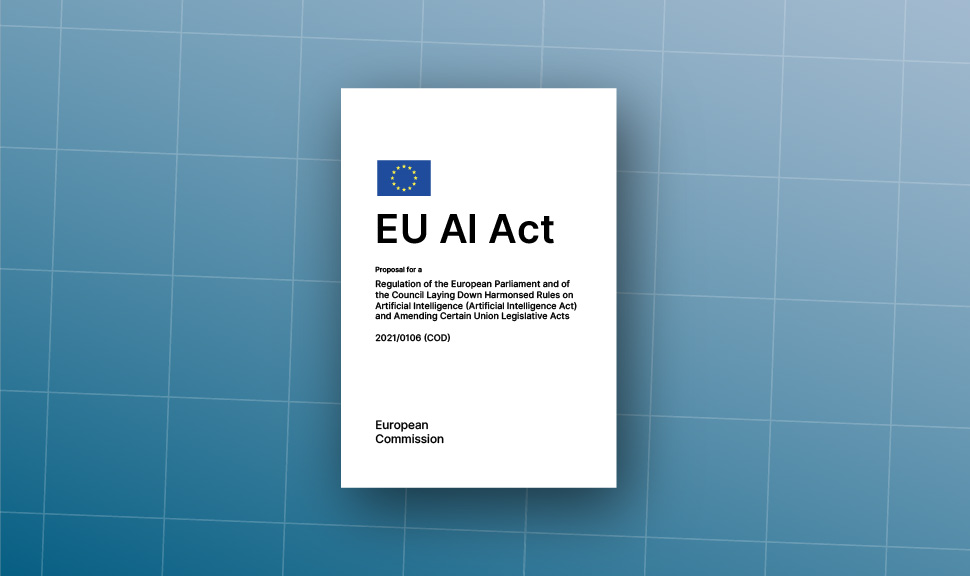
For high-risk applications—such as those used in critical infrastructure, employment, education, or financial services—the regulation introduces specific obligations. These include risk management systems, requirements for data quality, technical documentation, traceability of decisions, and mechanisms for human oversight.
For companies developing or deploying AI systems, these requirements will increasingly need to be integrated into governance frameworks.
Seen from this perspective, the AI Act should not be viewed purely as a compliance exercise. It can also serve as a catalyst for more mature and structured approaches to AI adoption.
At e-Novia, we support companies in this transition. Our consulting projects help organizations design Physical AI adoption strategies that combine business priorities, governance frameworks, use-case development, and regulatory awareness—turning compliance into a driver of long-term resilience and value.
Treating regulation purely as a constraint would be short-sighted.
Leading organizations increasingly view governance and regulatory alignment as an opportunity to strengthen their innovation strategies.
The AI Act pushes companies toward greater transparency, accountability, and control in the development and deployment of AI systems. When embedded effectively into business processes, these principles can make AI adoption more robust and scalable.
In this sense, AI governance becomes a strategic capability.
Companies that successfully integrate technology, organizational capabilities, and accountability into their decision frameworks will be best positioned to capture the opportunities created by artificial intelligence.
For e-Novia, this is a central point.
AI creates value when strategic vision, execution capabilities, and industrial expertise come together.
Our work sits precisely at that intersection: helping companies define their innovation direction while translating emerging technologies into real-world applications.
Our model combines Venture Studio and Innovation Consulting. Across both activities, the common thread is Physical AI—the integration of artificial intelligence with advanced sensing technologies and intelligent physical systems.
On one side, we help develop high-potential new ventures. On the other, we support established companies in integrating these technologies into industrial products and operational processes.
The objective is to move beyond digital experimentation and translate AI into innovation applied to the physical world.
When companies move from vision to execution, the challenge is not launching more experiments. It is identifying the most promising opportunities, prioritizing the right use cases, and building the systems needed to deliver measurable impact.
Ultimately, the future of artificial intelligence in business will depend less on access to new technologies and more on how effectively organizations govern them.
For Europe, one of the most promising opportunities lies in leveraging a strength it already possesses: a strong industrial base.
This is where Physical AI becomes particularly relevant. When artificial intelligence moves into the physical world—through robotics, intelligent machines, and industrial systems—competitive advantage rarely depends on the model alone.
Infrastructure, engineering capability, and execution matter more.
Success depends on selecting the right applications, integrating AI with sensors, automation, and real operational data, and translating those systems into measurable business value.
For countries such as Italy, with a deep manufacturing tradition, this represents a tangible opportunity to build a distinctive competitive advantage.
This is exactly the principle that guides e-Novia’s approach: supporting companies throughout the entire innovation cycle—from concept definition to large-scale integration—transforming Physical AI into real industrial innovation.
In the end, AI governance is fundamentally a leadership issue.
It requires setting direction, defining priorities, and ensuring that a powerful technology translates into lasting value.