Rapid Prototyping: The Strategic Accelerator for Industrial Innovation
Discover how rapid prototyping and Physical AI reduce investment risks in product dev...

On January 21–22, 2026, at Bocconi University in Milan (Roentgen Building), AI Festival focused its 2026 edition on “Empowering the Agentic Era”—a phase in which Artificial Intelligence is evolving toward more autonomous systems, able to collaborate proactively and take on increasingly operational roles.
Across perspectives ranging from business and technology to governance, one message came through clearly: AI can no longer be treated as a simple digital upgrade. It is a transformation that requires deliberate choices—about architectures, responsibilities, capabilities, data, and purpose.
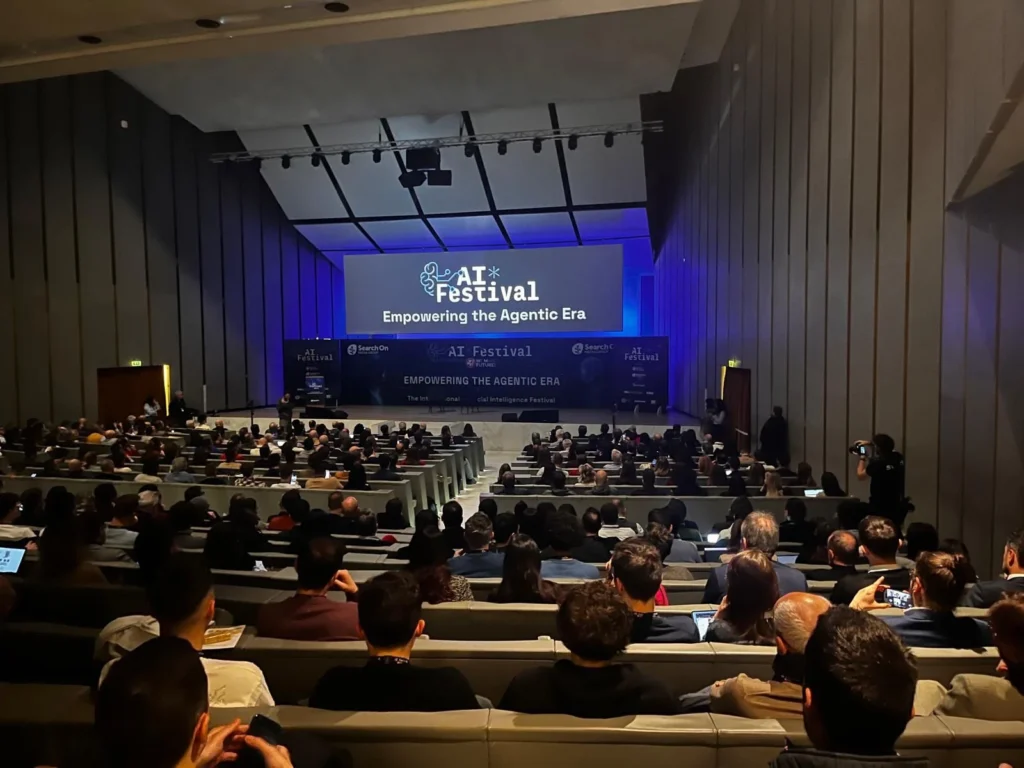
Within this context, e-Novia participated with a precise positioning: Physical AI. We work on AI when it must be integrated into physical and industrial systems, where software and hardware must operate together reliably and safely—sensor systems, embedded computing, real-time constraints, safety, product design, and process integration. This is where AI moves from a demonstration to a repeatable capability.
One of the most recurring messages over the two days was the shift beyond an “exploratory” phase: AI is no longer just potential, but a technology that forces architectural, organizational, and cultural decisions.
For e-Novia, this is a confirmation of an operational reality: competitive advantage rarely depends on the model itself. It depends on the ability to turn AI into operational capabilities, measurable and governable. In practice, this means:
In other words, adoption is not a purely technological exercise: it is an execution choice.
Discussions with companies and ecosystem players reinforced a key point: AI is becoming increasingly infrastructural and competitive. The question is not “whether” to adopt it, but how to do so at the speed required by market pressure—skills, integration, scalability, security, and economic sustainability.
From this perspective, the opportunity for Italy is tangible, provided the country accelerates on adoption and industrialization capability, not only experimentation and proof-of-concepts.
The agentic era makes an often-overlooked distinction even more relevant: integrating AI into software is one thing; enabling it to operate in physical contexts, where systems must meet non-negotiable constraints, is another.
For e-Novia, Physical AI means designing systems where the following dimensions matter simultaneously:
This integration is where the difference between a prototype and an industrial-grade solution becomes measurable.
At the event, we shared examples that make Physical AI tangible.
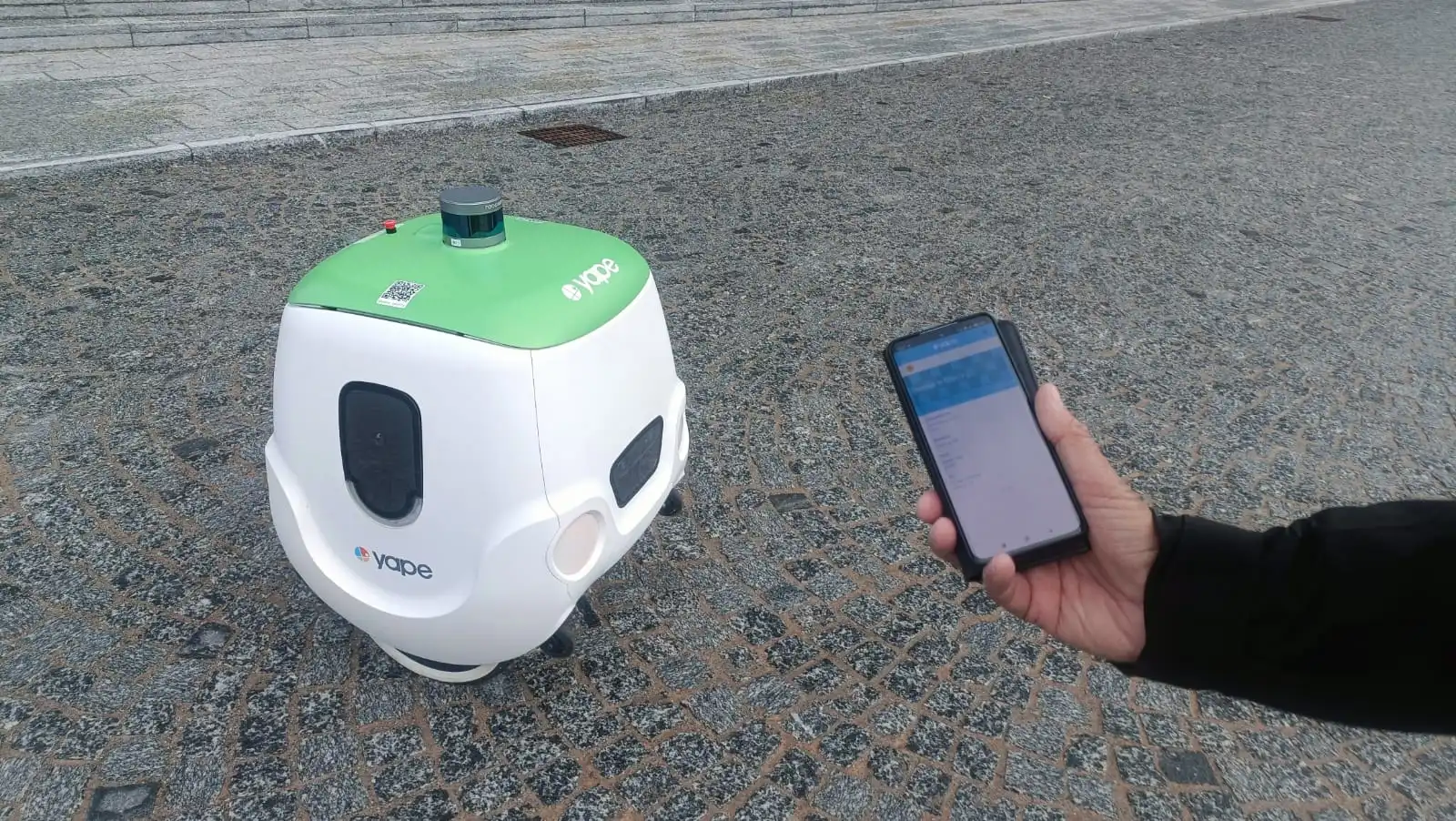
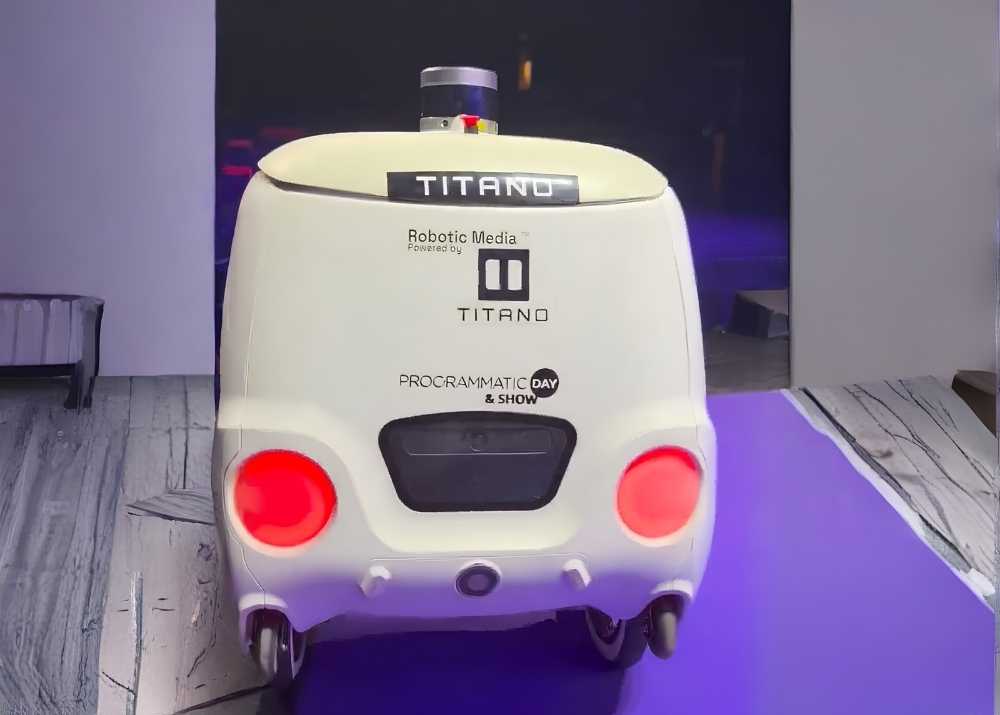
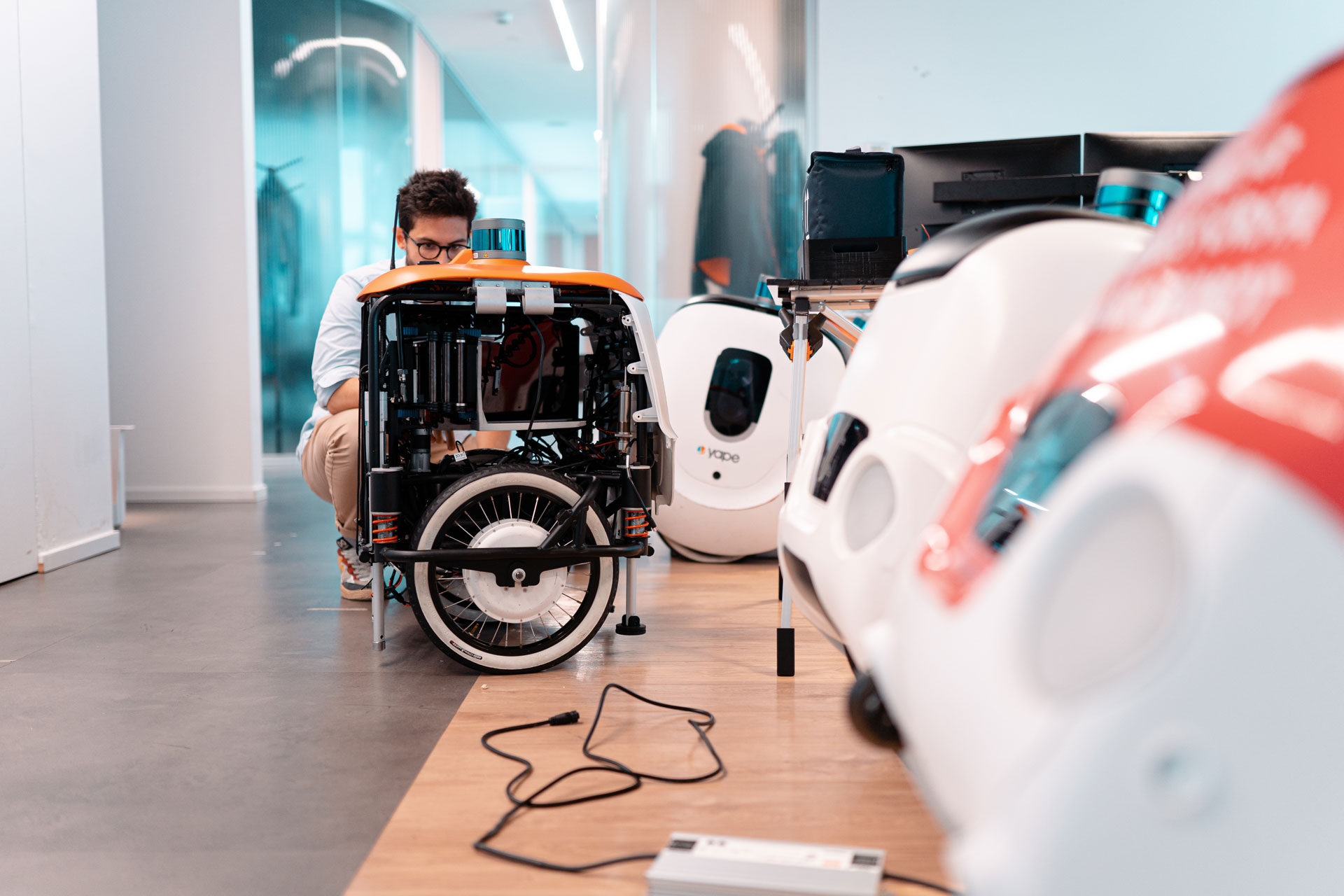
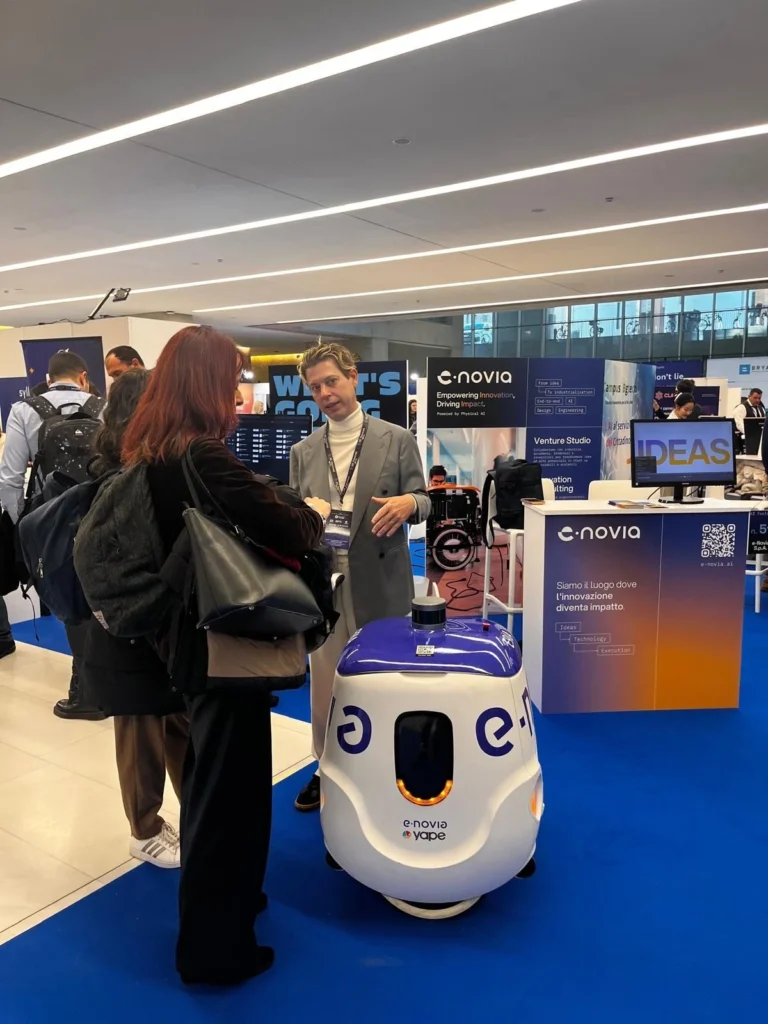
YAPE: a ground delivery robot for last-mile logistics, where autonomy and operational continuity depend on the integration of perception (sensing), control (embedded), and algorithms—under real safety and context constraints. It is a case where quality is not measured only in perception accuracy, but in robust behavior in dynamic environments.
Weart: haptic gloves enabling tactile feedback on digital replicas and simulations. A relevant building block for use cases such as industrial training and validation in virtual environments, where interaction quality, fidelity, latency, coherence, becomes a product requirement, not a detail.
Different technologies, same challenge: turning AI + hardware into systems that are reliable, usable, and integrable.
Within the Innovation Arena, Federico Moro, Head of e-Novia Venture Studio, shared an operational perspective on a concrete question: what changes in processes and people when Agentic AI enters venture building.
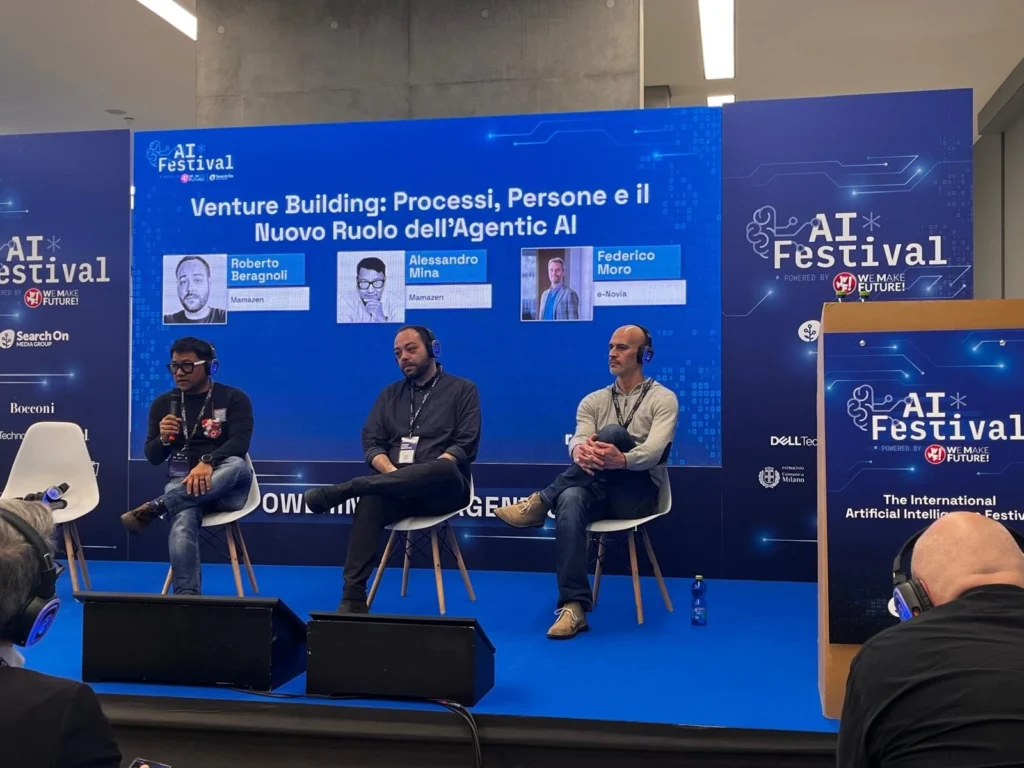
La tesi è chiara: gli agenti possono aumentare significativamente velocità e ampiezza del lavoro nelle fasi iniziali, dalla generazione di insight alla strutturazione della validazione, ma il valore non arriva “in The point is clear: agents can significantly increase speed and breadth in the early stages, from insight generation to structuring validation, but value does not appear automatically. It emerges when adoption is designed as a working system, with defined rules and responsibilities.
More specifically, acceleration becomes sustainable only if three elements are built:
In short, Agentic AI does not replace method: it makes method even more necessary. Without these safeguards, higher speed can generate more output—but not better decisions—and in early-stage environments that cost is immediate.
AI Festival dedicated significant space to governance, rights, and responsibility: data protection, digital sovereignty, accountability. These issues become unavoidable as systems increase autonomy and influence over processes.
In parallel, the discussion on impact and sustainability reaffirmed a critical point: AI’s real-world effect depends on how systems are designed—data, infrastructure, objectives—and what consequences they produce. It is not a matter of intentions, but of design choices and measurement.
AI Festival 2026 confirmed that AI is moving toward more autonomous and operational usage models. In this scenario, the differentiator is the ability to move from experimentation to systems that are reliable and integrable.
This is exactly where e-Novia’s positioning sits: Physical AI, meaning the industrialization of AI in the real world—where algorithms and hardware must operate together safely, under concrete constraints and measurable goals.
Discover how e-Novia supports companies and researchers in adopting Physical AI technologies.